





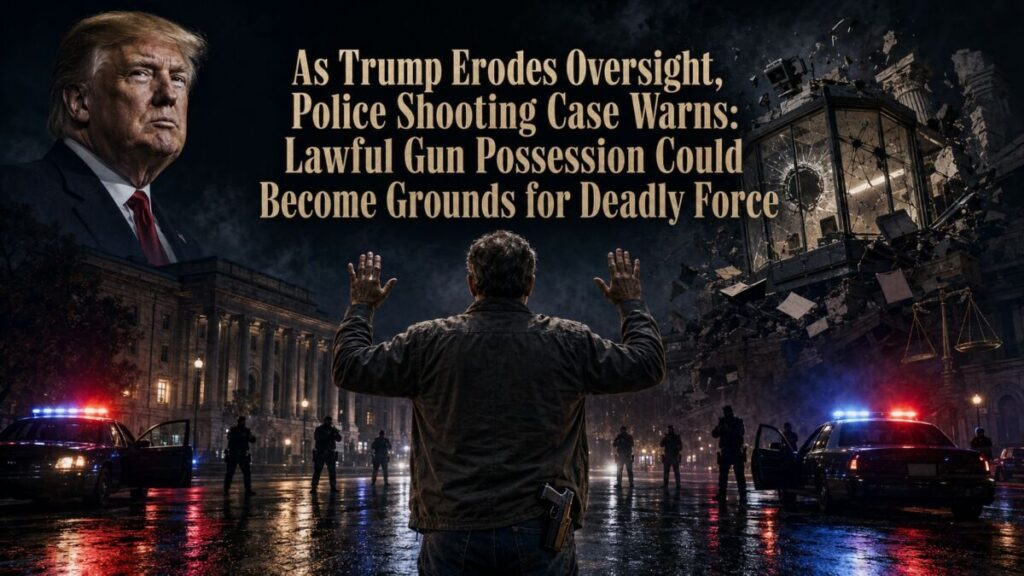
WASHINGTON, D.C. — As the Trump administration weakens the few remaining mechanisms for independently investigating government misconduct, a police-shooting case left undisturbed by the U.S. Supreme Court warns that lawful firearm possession could be transformed from a constitutional right into grounds for being shot by police without warning.
In Green v. Tanner, judges—not a jury—decided that a police officer acted reasonably in shooting an armed, off-duty officer outside his own home, despite disputed evidence about what the shooting officer saw and whether the victim appeared to pose a threat. The appeals court relied on the sweeping proposition that no constitutional or statutory right prevents an officer from using deadly force when faced with “an apparently loaded weapon.” In appealing to the Supreme Court, The Rutherford Institute, Cato Institute, Law Enforcement Action Partnership and the Southern Center for Human Rights warned that the ruling threatens the Second Amendment right to bear arms, the Fourth Amendment protection against unreasonable force, and the Seventh Amendment right to have disputed facts decided by a jury.
“Lawfully possessing a firearm cannot be turned into a death warrant,” said constitutional attorney John W. Whitehead, president of The Rutherford Institute and author of Battlefield America: The War on the American People. “Yet with the Trump administration dismantling the few mechanisms left for holding government officials accountable—independent investigations, public transparency, civil rights lawsuits and jury trials—the police state is increasingly being allowed to police itself. When government agents use deadly force, their own agencies control the evidence, their own lawyers defend them, and judges prevent juries from deciding whether the agent’s conduct was reasonable, accountability becomes an illusion.”
- Buy All-American!
- Bring health and vitality back to your body with these non-transdermal patches
- Get your Vitamin B17 & Get 10% Off With Promo Code TIM
- How To Protect Yourself From 5G, EMF & RF Radiation - Use promo code TIM to save $$$
- The Very Best All-American Made Supplements On The Market
- Grab This Bucket Of Heirloom Seeds & Save with Promo Code TIM
- Here’s A Way You Can Stockpile Food For The Future
- Stockpile Your Ammo & Save $15 On Your First Order
- Preparing Also Means Detoxifying – Here’s One Simple Way To Detoxify
- The Very Best Chlorine Dioxide
- All-American, US Prime, High Choice Grass-Fed Beef with NO mRNA, hormones or antibiotics... ever!
The case arose after Milton Green, a 15-year veteran of the St. Louis Metropolitan Police Department, was shot by another officer during a pursuit near Green’s home. Green, who was off duty, drew his firearm after an armed suspect ran through his yard. According to Green, his gun was pointed toward the ground and he displayed his police badge. A detective recognized Green and repeatedly warned the surrounding officers not to shoot. Nevertheless, another officer shot Green, later claiming that he mistook him for the fleeing suspect and his badge for a gun. The shooting permanently injured Green and ended his police career.
Green filed a civil rights lawsuit, arguing that a jury should decide whether the officer’s claimed mistake was reasonable because the facts were disputed and the officer admitted that he did not see the badge in Green’s hand. Green never received a jury trial. The district court dismissed the case before trial, and the Eighth Circuit Court of Appeals affirmed, concluding that the use of deadly force was objectively reasonable. The coalition warned that if the apparent presence of a firearm permits deadly force as a matter of law, lawful gun ownership itself may be transformed from a protected constitutional right into grounds for being shot without warning. The danger extends beyond one police shooting. The ruling dismantles key safeguards and leaves government officials in control of every stage of the process: using force, controlling the evidence, defending the conduct and deciding whether the official account will ever be tested before a jury.
Matthew P. Cavedon and Alexander M. Xenos of Cato Institute advanced the arguments in the Green v. Tanner amicus brief.
Green v. Tanner
Article posted with permission from John Whitehead