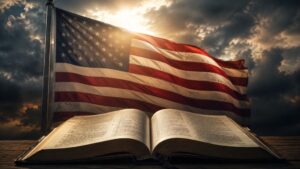



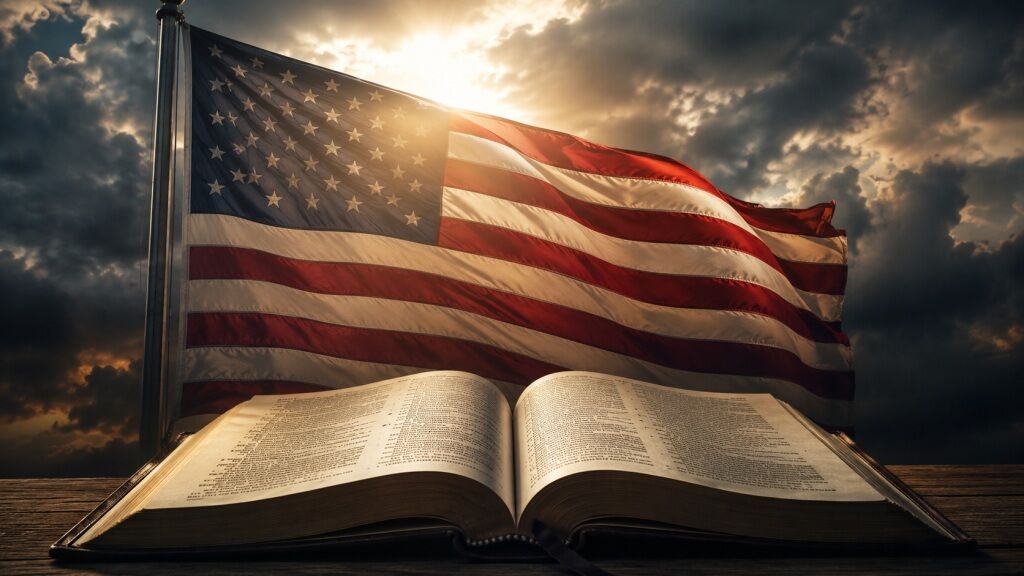
On the 250th anniversary of their country’s independence, Americans must remember that the Declaration of Independence signed on July 4, 1776 was the product of thousands of years of history. The Founders were indeed brilliant men. But the Declaration they crafted was no mere political manifesto born of Enlightenment abstractions or secular grievances. They certainly did not invent the ideas.
Rather, the Declaration was the climax of the outworking of centuries of biblical truths spreading throughout the world. This expansion shaped laws, governments, and the very conscience of a people determined to live under God’s authority rather than the whims of tyrants. Despite the absence of these facts from modern-day “history” books, the historical record and the Founders themselves are clear.
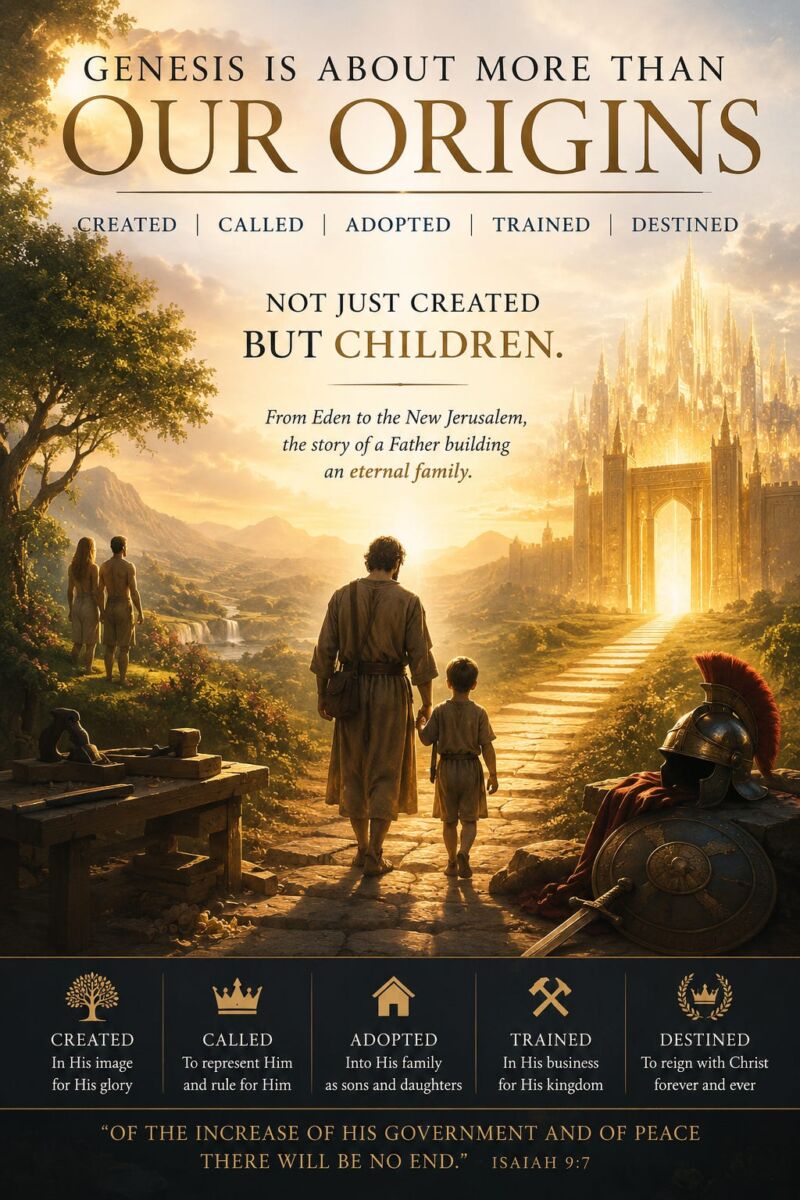
From Genesis to Revelation, God shows that He is sovereign, that people are made in His likeness and image, and that He created moral laws to govern men as surely as He ordained physical laws to govern the universe. The principles embodied in the Holy Scriptures echoed throughout history and directly shaped the thinking of America’s Founders and the early settlers who laid the foundation for their historic declaration.
- Buy All-American!
- Bring health and vitality back to your body with these non-transdermal patches
- Get your Vitamin B17 & Get 10% Off With Promo Code TIM
- How To Protect Yourself From 5G, EMF & RF Radiation - Use promo code TIM to save $$$
- The Very Best All-American Made Supplements On The Market
- Grab This Bucket Of Heirloom Seeds & Save with Promo Code TIM
- Here’s A Way You Can Stockpile Food For The Future
- Stockpile Your Ammo & Save $15 On Your First Order
- Preparing Also Means Detoxifying – Here’s One Simple Way To Detoxify
- The Very Best Chlorine Dioxide
- All-American, US Prime, High Choice Grass-Fed Beef with NO mRNA, hormones or antibiotics... ever!
The mission was both spiritual and civilizational. The goal: build a society in which the Bible’s message of liberty could flourish and reach those not yet enlightened by God’s word as part of the expansion of His kingdom. They saw the founding of America as another milestone in God’s larger story.
There are countless events, people, and ideas that paved the way for the establishment of the freest nation in history. A thousand books could not contain them. From Noah to Abraham and Moses to Jesus Christ, all were critical. The spread of their stories and the insights God gave through them brought light to people everywhere by way of missionaries, explorers, and evangelists. The result: liberty, peace, and prosperity expanded.

Unfortunately, much of the history leading up the creation of the United States — essential steps in the arc of God’s broader story — has been suppressed. But as America celebrates its 250th birthday, it is essential to restore an understanding of history. Without it, America will not survive as a free and independent nation — much less become “great” again.
This overview, while not exhaustive, highlights some key historical developments that paved the way for 13 British Colonies in North America to become independent — and to be forged into what would ultimately become the freest nation in the history of the world, taking the Bible and civilization to more people than any other country.
The Bible & the Light of the Gospel
The Founders believed Divine Providence — the hand of Almighty God — was guiding the chain of events that prepared the ground for the Declaration. Thousands of years ago, God gave profound insights on law, morality, and government to Moses and the nation He created through Abraham. This offered “light to the nations” in the region. But with the birth, death, and resurrection of Jesus Christ, those insights — and new ones previously hidden — exploded into the world. What began with Christ and His 12 disciples 2,000 years ago transformed Europe, North Africa, the Middle East, and, finally, the Americas.
From the triumph of the Gospel in the Roman Empire to the covenantal compacts of the New World, from the Black Robed Regiment of patriot pastors to the thunderous sermons that steeled Colonists against tyranny, the hand of God appears unmistakable. The men who produced the Declaration stood on the shoulders of generations who had absorbed the biblical worldview. To forget this is to lose not just history, but the very liberty they secured.
The biblical blueprint for self-government and resistance to tyranny traces directly to ancient Israel, a pattern the Founders studied intently (see “The Biblical Principles of Our Founding Documents”). As Harvard chief Samuel Langdon explained to New Hampshire lawmakers in a 1788 sermon urging the ratification of the U.S. Constitution, “As to every thing excellent in their constitution of government, except what was peculiar to them as a nation separated to God from the rest of the world, the Israelites may be considered as a pattern to the world in all ages.”
These biblical ideas on government, culture, law, and society spread across the Roman Empire as Jesus’ followers carried out the “Great Commission.” This marked a great pivot in human history. Paganism retreated as Christianity triumphed amid ruthless persecution by Rome. This process transformed societies, laying the groundwork for Christian kings and laws — which even those kings were expected to obey — that rejected arbitrary rule.
As Christianity became established, infanticide, slavery, orgies, idol worship, lawlessness, unchecked tyranny, and other pagan practices were suppressed or at least went into the closet. This gave birth to “Christendom.” America was an outgrowth of this transformation that began in the Mediterranean region and eventually rocked the world.
Christianity in the Anglo-Saxon World
By the 9th century, this legacy reached King Alfred the Great of England (849-899). Facing pagan Viking invasions and lawlessness, Alfred wrote his Law Code based on the Bible: the Ten Commandments, parts of the Book of Exodus, the Sermon on the Mount, and the Acts of the Apostles. As Winston Churchill later wrote in A History of the English-Speaking Peoples, Alfred’s laws “attempted to blend the Mosaic code with Christian principles.” These became the foundation of English Common Law, embedding rights from the Creator, equal justice, decentralized power, and protection for the individual, family, and Church.
More than three centuries later, in 1215, barons and clergy — calling themselves the “Army of God” — forced King John to sign the Magna Carta at Runnymede. The document, written with guidance from the Archbishop of Canterbury, delineated rights for the Catholic Church, the right to petition for redress of grievances, no taxation without common counsel (consent), no excessive fines or punishment, due process of law, and the requirement of credible witnesses. Many of those ideas would be enshrined in America’s founding documents more than 500 years later.

The Magna Carta was so thoroughly rooted in the Scriptures that it famously ended with a prayer “for the salvation of our souls, and the souls of all our … heirs, and unto the honor of God.” The Colonists knew it well. When Britain imposed the Stamp Act, the Massachusetts Assembly rightly declared it “against the Magna Carta and the natural rights of Englishmen.” The U.S. Supreme Court has cited the Magna Carta in more than 100 rulings. That Great Charter declared that even kings must bow to God’s higher law.
The mass printing of the Bible, its translation into English, and its widespread diffusion throughout England, France, Germany, Holland, and Switzerland were among the most important developments in history — certainly of the last millennium. As knowledge of God’s Word and the ability of common men to access it spread, challenges to established political authority began to grow in tandem.
Several key developments involving theology would rock Christendom. Dissident Catholic priest and Oxford theologian John Wycliffe’s efforts to make the Scriptures available in English were revolutionary. While he was ultimately declared a heretic by the papacy, there was no going back: People would soon be able to read the Bible themselves. This changed everything and paved the way for even more significant challenges.
Another Catholic priest turned dissident, Martin Luther, building on Wycliffe’s writings, nailed his Ninety-five Theses to church doors in Wittenberg in 1517. This would forever upend the world, producing what eventually came to be known as the Protestant Reformation. Without it, virtually every historian agrees, there would have been no Declaration of Independence some 250 years later, establishing the United States in the New World.
Theologian John Calvin’s writings poured fuel on the fire in the 1530s. Especially critical was his articulation of what came to be known as the doctrine of the lesser magistrates. Calvin and other Reformation leaders believed inferior authorities had a duty to challenge higher ones and interpose when facing rule contrary to God’s laws. This was embraced by America’s Founders as they separated from England. Thomas Jefferson and James Madison later declared nullification and interposition by states the “rightful remedy” for federal abuses.
These theological and political developments produced even larger changes. One that would become critical was the historic refusal of the German city of Magdeburg in 1550 to submit to the Holy Roman Empire. In the Magdeburg Confession, the city’s political and religious leadership articulated the first Protestant justification for resisting political tyranny. Formally outlining the doctrine of the lesser magistrates, the document was a response to Emperor Charles V’s Augsburg Interim of 1548 ordering German Protestants to submit to Rome. The city’s refusal culminated in a year-long imperial siege ending in 1551 with Magdeburg’s victory.
Change was clearly in the air elsewhere, too. One of the most dramatic transformations occurred in England in 1534, when King Henry VIII broke from Rome to establish his own “Church of England” with himself as “supreme head.” He did so because he wanted to divorce his wife, but was not able to get permission to do so from the pope. Unencumbered by marriage vows and other moral laws, he remarried six times and had two of his wives beheaded. His actions later produced efforts to “purify” the English Church, fueling Puritan resistance to unbiblical and even anti-biblical use of authority by civil government.
The battle intensified in the English Civil War between 1642 and 1646. King Charles I sought to rule as a tyrant, dissolving Parliament and claiming absolute power. Puritan Christians, pointing back to the Magna Carta, rose up under Oliver Cromwell. Parliament went to war, defeated the king, tried him for treason, and executed him. Cromwell’s statue holding a sword and the Bible can still be found outside the British Parliament today. The history was well known to America’s Founders.
The principle of Lex Rex — “the law is king” — officially triumphed over Rex Lex (the king is law). Yes, even the king must submit to God’s law, even when it limits his power, explained philosopher Samuel Rutherford. If murder is wrong under God’s law, even kings may not murder. If theft is wrong, even monarchs must refrain from stealing. As legal scholar William Blackstone would explain in Commentaries on the Laws of England, which was constantly cited by America’s Founders and became the “bedrock” of American jurisprudence, God’s natural and revealed laws are supreme over all people and nations — even kings.
Of course, the idea of popular government and restrictions on the power of the state — whether ruled by a prince, king, emperor, or parliament — was not solely the invention of Protestant thinkers and theologians. Indeed, it had also been championed by some of the most important Catholic churchmen, theologians, and philosophers (including canonized saints and official Doctors of the Church) even prior to the Reformation. The Dominican friar St. Thomas Aquinas (1225-1274); Saint Cajetan (1480-1547), founder of the Theatine hospital order; Francisco de Vitoria (1483-1546); and Jesuits such as St. Robert Bellarmine (1542-1621), Francisco Suárez (1548-1617), and Juan de Mariana (1536-1624) were among the Catholic scholars who wrote extensively in favor of popular, constitutional government. Suárez’s writings were especially influential on Protestant thinkers in these matters, including Hugo Grotius and Samuel von Pufendorf, and were even adopted as textbooks in Lutheran and Puritan schools and universities. Suárez’s arguments in opposition to the English political theorist Robert Filmer, the prime defender of the “divine right of kings” for King James I, show up subsequently in the disputations of Protestant writers favoring popular sovereignty.
Christian Civilization Crosses the Atlantic
Around this time, Christian civilization began arriving in the New World from Europe. Following what he described as the prompting of the Holy Spirit and funded by the Catholic monarchy of Spain, Christopher Columbus famously sailed across the Atlantic in 1492. Spanish and Portuguese explorers and conquerors promptly began setting up Catholic colonies throughout the Americas, from Florida and Mexico to South America.
Many of the political and theological ideas fueling so much change in the Old World crossed the Atlantic, too. The first permanent English settlers arrived in Virginia on April 26, 1607. At this “First Landing,” Reverend Robert Hunt established a covenant: “We do hereby dedicate this Land, and ourselves, to reach the People within these shores with the Gospel of Jesus Christ, and to raise up Godly generations after us, and with these generations take the Kingdom of God to all the earth. May this Covenant of Dedication remain to all generations … and may this Land … be Evangelist to the World.” The giant cross planted there symbolized a new Christian civilization planted in the New World.

The Mayflower Compact of 1620 expanded on this foundation. The Pilgrims, “Having undertaken [this voyage] for the glory of God, and advancement of the Christian faith … do … covenant and combine ourselves together into a civil body politic.” It was the earliest example of Christian self-government in the New World.
The 1643 Articles of Confederation of the United Colonies of New England echoed the theme: “We all came into these parts of America with one and the same end and aim, namely, to advance the Kingdom of our Lord Jesus Christ and to enjoy the liberties of the Gospel in purity with peace.”
The seeds for the eventual creation of a mighty independent nation were being sown up and down the East coast of North America. But the Pilgrims sought more than just a Bible-based colony in which to live out their faith. Led by Governor William Bradford and Pastor John Robinson, they saw the colony as a deliberate mission to advance the Gospel in the “remote parts of the world.” Indeed, Bradford described their “great hope and inward zeal” of laying a foundation for spreading Christianity. They were happy to be mere “stepping-stones unto others” for the performance of such a great work, even if they did not live to see it, he said.
By the mid-18th century, spiritual declension threatened. Yet the “Great Awakening” (1740-1760) led by Jonathan Edwards, George Whitefield, and others (see “The Spiritual Foundation of American Independence”) produced a mighty revival. Churches overflowed. Many leaders who would pen the Declaration were children during this outpouring. It rekindled the biblical worldview, uniting Colonists across denominations in a fresh appreciation of liberty and the duty to resist ungodly rule.
American pastors, collectively known as the Black Robed Regiment, taught the biblical basis for resisting tyranny with crystal clarity, drawing from Scripture. In Exodus 1, Hebrew midwives feared God more than Pharaoh and refused his order to kill baby boys. God blessed them. Moses confronted Pharaoh repeatedly and, with God’s help, led his people to freedom. Elijah rebuked King Ahab: “I have not troubled Israel; but thou … hast forsaken the commandments of the Lord, and thou hast followed Baalim.” Shadrach, Meshach, and Abednego defied Nebuchadnezzar’s golden image, declaring their God able to deliver them — and He did, bringing the king himself to his senses. Daniel ignored King Darius’ decree against prayer, and God shut the lions’ mouths for him.
In the New Testament, Peter and the apostles told the Sanhedrin, “We ought to obey God rather than men” (Acts 5:29). Indeed, the early church was accused of “turning the world upside down” by proclaiming “another king, Jesus,” as recorded in Acts 17:7. Among the American Colonists longing for independence from British tyranny, a similar cry rang out: “There is no king, but King Jesus!”
These lessons thundered from Colonial pulpits. Pastors preached Christian liberty and the duty to resist tyrants. When British troops marched on Lexington and Concord in 1775 to seize guns, it was Reverend Jonas Clark — a pastor — who rallied the militia. “From this day will be dated the liberty of the world,” he said. The “shot heard round the world” was almost certainly fired by men who had heard such sermons.
Committees of Correspondence organized by “Father of the American Revolution” Samuel Adams circulated the “Rights of the Colonists” in 1772. Citing the New Testament, Adams said: “The rights of the colonists as Christians may be best understood by reading … the institutes of the Great Law Giver…. First, a right to life, Second, a right to liberty, Third, a right to property, together with the right to defend them.”
In May 1775, the Mecklenburg Declaration, adopted by Presbyterian leaders in North Carolina, called for independence while citing God as the authority. The phrasing inspired the 1776 Declaration with strong biblical language.
The Founders believed Divine Providence orchestrated it all. From the covenant at Virginia’s shores to the revival fires of the Great Awakening, from the model of the Hebrew Republic to the English struggles for Lex Rex, God had prepared a people “for such a time as this.” The Declaration was not the beginning, but the culmination — the political fruit of a Gospel that had transformed hearts and minds for centuries, going back to the time of Christ and even earlier.
Yet the warning from Scripture remains urgent. In 1 Samuel 8, when Israel demanded a king “like all the nations” and rejected God’s direct rule, Samuel foretold the inevitable: The king would take their sons, daughters, fields, and a tenth of their increase, reducing them to servants. “And ye shall cry out in that day … and the Lord will not hear you.” America’s Founders knew this history. They chose the biblical path of limited, republican government under God.
Today, as forces clamor to rewrite the Constitution, centralize power, and erase the nation’s Christian heritage, the lessons should be clear. Without an understanding of these facts and a return to the biblical worldview that produced the Declaration, there can be no restoration of liberty or self-government.
As Samuel Langdon thundered in his 1788 sermon to the New Hampshire General Court: “Preserve the knowledge of God in the land, and attend to the revelation written to us from heaven. If you neglect or renounce that religion taught and commanded us in the holy scriptures, think no more of freedom, peace, and happiness; the judgments of heaven will persue you (sic).” That warning is more relevant today than ever.
May Americans in 2026, like the Black Robed Regiment and the signers of 1776, choose to obey God rather than men. Only then can the nation reclaim the promise inscribed on the Liberty Bell from Leviticus: “Proclaim liberty throughout all the land unto all the inhabitants thereof.” The God who delivered Shadrach, Meshach, and Abednego from the furnace, who shut the lions’ mouths for Daniel, and who guided George Washington’s ragtag army still reigns today. The choice is clear: Be governed by God, or by tyrants.