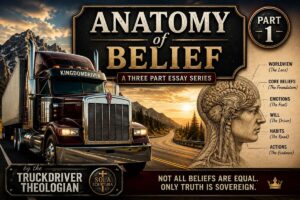





I have changed my mind about enough important things over the years to learn something uncomfortable: changing your mind is rarely just a matter of changing your mind. We like to imagine ourselves as rational creatures who examine the evidence, weigh the arguments, and follow the facts wherever they lead. Sometimes we do. But anyone who has spent much time observing people—or himself—knows better. We approach reality with loyalties, fears, friendships, ambitions, habits, histories, reputations to protect, and people whose approval matters to us. Beneath all of that, we have hearts that worship.
Our paradigm is more than a collection of beliefs. It is the framework through which we interpret everything else. It tells us which facts matter, which questions are permissible, which conclusions are unthinkable, and which voices deserve to be heard. Most of the time, we do not even know we have one. We simply call it reality. Then facts begin appearing that do not fit. We dismiss them, explain them away, or make exceptions. Eventually, if we are fortunate—or perhaps if God is merciful—the exceptions begin piling up faster than our explanations. The old house starts creaking.
- Buy All-American!
- Bring health and vitality back to your body with these non-transdermal patches
- Get your Vitamin B17 & Get 10% Off With Promo Code TIM
- How To Protect Yourself From 5G, EMF & RF Radiation - Use promo code TIM to save $$$
- The Very Best All-American Made Supplements On The Market
- Grab This Bucket Of Heirloom Seeds & Save with Promo Code TIM
- Here’s A Way You Can Stockpile Food For The Future
- Stockpile Your Ammo & Save $15 On Your First Order
- Preparing Also Means Detoxifying – Here’s One Simple Way To Detoxify
- The Very Best Chlorine Dioxide
- All-American, US Prime, High Choice Grass-Fed Beef with NO mRNA, hormones or antibiotics... ever!
No Neutrality
The Bible understood this long before modern psychology gave us terms like confirmation bias and cognitive dissonance. Scripture does not describe man as a detached intellect gathering facts and reaching conclusions. But a creature who manages inconvenient truths and constructs explanations that permit us to continue living as we wish.
Modern psychology calls one aspect of this confirmation bias. We notice evidence that supports what we already believe and discount evidence that threatens it. But the Bible goes deeper. The mind is often defending the ruling loves of the heart. A man committed to autonomy will find arguments for autonomy. A man whose identity depends upon his political tribe will interpret events in ways that protect his tribe. A minister whose income, friendships, and reputation depend upon a theological position may discover that biblical evidence against it is remarkably difficult to see.
This does not mean everyone who disagrees with us is dishonest. It means none of us is neutral.
We Believe Collectively
People do not usually hold beliefs in isolation. We belong to families, churches, denominations, political movements, professions, and social circles. Every community develops boundaries around what reasonable people are permitted to believe. Some questions are encouraged. Others will quietly remove you from the Christmas card list.
The Bible recognizes this social dimension of belief. “He who walks with the wise grows wise.” “Bad company corrupts good morals.” “The fear of man lays a snare.” Perhaps one of the most penetrating things Jesus ever said about human belief was, “How can you believe, when you receive glory from one another?”
There are truths a man cannot admit while the approval of other men remains his highest good. Changing your mind can be expensive. You may lose friends, position, audience, or reputation. You may discover that people who praised your courage when you challenged someone else’s tribe are considerably less enthusiastic when you challenge theirs. Many people see the evidence long before they admit the conclusion. They are calculating the cost.
When the Pieces Don’t Fit
Cognitive dissonance describes the discomfort we experience when our beliefs contradict one another, or when our behavior contradicts what we claim to believe. When the story we tell ourselves collides with something we can no longer explain, we have choices. We can repent, rationalize, avoid the subject, attack the messenger, or retreat deeper into the tribe and ask our friends to reassure us that we were right all along.
People often become angriest when an argument gets closest to the foundation of their worldview. Anger is not proof that a man knows he is wrong; sometimes anger is righteous. But sometimes anger is the smoke rising from cognitive dissonance. Something has been touched that the man cannot afford to examine.
What Produces Change?
If arguments alone changed people, the world would be filled with reasonable men. It is not.
Paradigm shifts usually occur when several things converge. Facts accumulate that the old framework can no longer explain. Crisis enters the picture, and failure, suffering, betrayal, or death expose assumptions we never thought to question.
Perhaps someone we trust tells us the truth. People are not usually driven to a new worldview by strangers shouting at them. Truth often enters through relationship: a faithful friend, a patient teacher, a courageous pastor, or simply a man whose life makes his words difficult to dismiss.
Finally, there must be humility. Changing one’s mind means admitting that the person you were yesterday was wrong, sometimes after defending that position for years or teaching it to others. The longer we have held a position, the more expensive repentance becomes. But the alternative is worse: spending the remainder of our lives defending an error because we are embarrassed to admit how long we believed it.
Conversion
All of these point toward the greatest paradigm shift a man can experience: conversion. The Christ who once seemed irrelevant becomes the center of one’s reality. But conversion does not eliminate confirmation bias. Christians still have traditions, denominations, favorite teachers, theological systems, reputations, ministries, and audiences. We can become remarkably skilled at confusing loyalty to our system with loyalty to God.
The Pharisees searched the Scriptures. Their problem was not biblical illiteracy. They possessed a framework that was incompatible with the Messiah standing in front of them. That is why theological debates often go nowhere. Two men may quote Scripture to one another for hours while never examining the assumptions that determine how they organize and interpret those Scriptures.
Sometimes the real question is not, “What does this verse say?” The real question is, “What would it cost me if this verse means what I am beginning to suspect it means?”
Cognitive Dissonance

For the Christian, cognitive dissonance can be a blessing. We say God is sovereign, yet live in fear. We preach grace yet refuse to forgive. We confess Christ as Lord yet negotiate with sins we have yet to abandon.
That discomfort may be God disturbing our hypocrisy. The Christian life is not one paradigm shift followed by perfect understanding. Conversion begins the renewal of the mind, and God spends the rest of our lives exposing falsehoods we carried into the kingdom with us—false ideas about God, ourselves, success, suffering, power, love, the church, and the world. Sanctification is, among other things, a long series of Spirit-produced corrections.
Some people never change because the old paradigm still pays too well. It gives them status, protects them from shame, preserves friendships, secures income, excuses behavior, and keeps them safely inside the tribe.
People do not believe merely because their beliefs are convincing. Sometimes their views, though wrong, are useful. Truth makes demands. It rearranges loyalties, destroys excuses, and may require change, and that can become expensive. As I have grown older, I am less interested in asking whether other people are biased. Of course they are. So am I. The more important question is what I believe that I cannot afford to question. What conclusion must remain true for my reputation, friendships, theology, politics, or identity to remain undisturbed? What evidence do I dismiss too quickly? Which voices am I unwilling to hear? What will I have to admit if I am wrong?
Article posted with permission from Bill Evans