


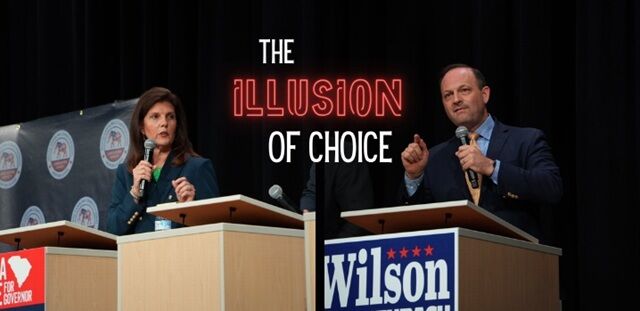
South Carolinians complain about the status quo constantly. They say they want change, new faces, fresh leadership. But when the moment arrives to actually vote for it, they pull the same lever and call it a revolution. Once again, the June 9th primary produced exactly the result the political establishment needed…a crowded field that eliminated every serious threat while leaving two establishment picks: Attorney General Alan Wilson standing across from Lieutenant Governor Pamela Evette. On June 23rd, Wilson won the runoff decisively, the race called in his favor within half an hour of polls closing. Both candidates, in their own way, were bred to perpetuate the same political dynasty. So how did a state full of voters who claim to want something different end up with the same rulers in power? We took a close look at how we got here and will let you decide the rest.

Who Were the Candidates?
Alan Wilson is the son of longtime U.S. Congressman Joe Wilson and has served as South Carolina’s Attorney General since 2011, the longest-serving AG in the state’s modern history. He built that tenure by keeping the right allies close and the wrong questions far away. As we have documented extensively at Palmetto State Watch Foundation, Wilson’s office has bought political favor by handing out Litigation Retention Agreements to the law firms of powerful lawyer-legislators, as well as other political insiders in South Carolina, creating a loop in which the same people who fund his campaigns also profit from his office and then approve his budget. It is also well known among capitol observers that Wilson does not take unscripted questions from the public at speaking events. South Carolinans just nominated a Republican candidate for governor who won’t stick around to answer them.
Wilson chose state senator Mike Reichenbach as his Lt. Governor running mate. Reichenbach is an Ohio native who voted to pass hate crimes legislation just last year. Reichenbach, his businesses, and close relations made generous contributions to Wilson’s campaign totaling $21,000 in March 2026.
- Buy All-American!
- Bring health and vitality back to your body with these non-transdermal patches
- Get your Vitamin B17 & Get 10% Off With Promo Code TIM
- How To Protect Yourself From 5G, EMF & RF Radiation - Use promo code TIM to save $$$
- The Very Best All-American Made Supplements On The Market
- Grab This Bucket Of Heirloom Seeds & Save with Promo Code TIM
- Here’s A Way You Can Stockpile Food For The Future
- Stockpile Your Ammo & Save $15 On Your First Order
- Preparing Also Means Detoxifying – Here’s One Simple Way To Detoxify
- The Very Best Chlorine Dioxide
- All-American, US Prime, High Choice Grass-Fed Beef with NO mRNA, hormones or antibiotics... ever!

Josh Kimbrell, a state senator from Spartanburg who is the focus of at least one current civil lawsuit and now a federal inquiry, never had a credible path to the nomination. He functioned less as a serious candidate and more as a placeholder, fragmenting Upstate conservative votes during the months they were most needed elsewhere. Right before the primary, Kimbrell suspended his campaign and immediately endorsed Wilson. Whatever voters he had been holding for himself he handed directly to the man who benefited most from keeping the field crowded for as long as possible.
Ralph Norman, a U.S. Congressman from Rock Hill and one of the most conservative members of the House Freedom Caucus, was the candidate who seemed to make the most sense on paper for voters who genuinely wanted something different from the establishment. However, he stumped for Nikki Haley in 2024 rather than Trump, which cost him in a field where loyalty to the President was treated as a prerequisite. Norman finished third with 17% of the vote, and his voters, concentrated in the Upstate counties around Greenville, became a valuable bloc in the runoff. In the wake of his primary loss, he endorsed Wilson, directing more of those scattered conservative votes toward Wilson.
Nancy Mace is a figure who has never lacked for controversy. The U.S. Congresswoman from the Lowcountry ran a combative campaign, frequently targeting Wilson by name and accusing him of running a political hit job against her. Wilson, for his part, was not shy about returning fire. When she finished fifth on election night, before the results were even fully counted, Mace endorsed Wilson, the man she had spent months attacking, predicting he would “mop the floor” with Evette. According to the International Business Times, Mace also accepted a position helping pursue sexual crimes cases in a future Wilson administration, a remarkable pivot for a candidate who spent the better part of a year accusing him of dismissing child sex crime cases, dropping charges against convicted predators, and turning a blind eye to crimes against women.
Rom Reddy, a wealthy Lowcountry businessman who entered the race in March and self-funded his entire campaign, was the most interesting “disruptor” in the field. He surged in the polls after releasing a tabloid-style newspaper that covered his platform and went after his opponents. Reddy climbed. When Trump endorsed Evette, that gave her enough of an edge to come in second while Reddy’s window closed.

After the results came in, Reddy told reporters publicly that he would not be endorsing anyone. Within 24 hours, he had posted a backhanded endorsement for establishment-backed, *ahem* Wilson-supported AG candidate, Stephen Goldfinch.
Pamela Evette is an Ohio native and South Carolina’s current Lieutenant Governor. She finished first in the primary at 29% propelled by a Trump endorsement and a campaign operation that included Trump’s longtime pollster Tony Fabrizio. She attended two out of the four debates scheduled during the primary, as well as one with Wilson on June 16th in Conway prior to the runoff. There were ongoing rumors throughout the race that she planned to pick Governor McMaster’s son as her running mate, which would have made the entire arrangement a rather tidy family business transaction. She later released a lengthy list of potential catch-all running mates, some of whom we understand were not even contacted by Evette prior to being added to the list on the eve of the runoff election.
Political Circus
A lot of people appeared genuinely confused by the two Trump endorsements. It’s not that complicated. Politics is a circus and this one was no exception.

After the primary but before the runoff, Trump endorsed both candidates, calling Evette an America First patriot while also extending overtures toward Wilson. The president, it appears, is comfortable with whoever emerges. So is the machine. Evette conceded to Wilson the night of June 23rd without offering any explanation for what comes next once her term ends.
Both Evette and Wilson are establishment picks, full stop. Wilson spent the primary working hard to convince voters otherwise, positioning Evette as the establishment candidate while casting himself as the outsider. That framing was never true and it was not new.
Wilson’s establishment roots begin before all of these donor networks or consulting firms. In fact, they go far back with Henry McMaster. When McMaster vacated the Attorney General’s office in 2010 to become Lieutenant Governor, Wilson was his successor. Now, sixteen years later, Wilson is running to succeed McMaster again, this time for the governorship McMaster has held since 2017. This is not an outsider seeking office, it’s an establishment institution seeking a promotion.
Some will point to McMaster’s endorsement of Evette as evidence that Wilson is not the establishment’s chosen instrument, a fair observation that deserves a direct answer. An endorsement for one and donations to both: different moves, same playbook, same network. As we document in The Donations section of this article below, a search of the SC Ethics Commission’s campaign contribution database shows long-time Wilson donors appearing in Evette’s records as well. When your network has placed acceptable candidates in both lanes, it does not matter which one crosses the finish line.
Here is what actually happened in this race. With a crowded primary field, Wilson had no path to a clear majority. His campaign knew a runoff was coming, and they knew South Carolinians wanted change. The play was to control who he faced in it. Split the anti-establishment vote across enough candidates that none of them consolidated, then watch those candidates fold and endorse Wilson when they lost.
We mentioned Kimbrell’s endorsement. And Mace’s. Soon after they folded, we publicly questioned whether Reddy would endorse Wilson too.
The connective tissue here is worth examining closely.
Pay to Play
Let’s take a look at the intricate ties to the Republican Attorneys General Association (RAGA). Wilson was there at RAGA’s founding (keep reading for more information on RAGA.) Wilson was elected chair in November 2013, two months before the organization officially came into existence in January 2014. Rather than being just an early participant in RAGA, Wilson was its chair before it had a door to open. RAGA paid Push Digital, whose co-founder was Wesley Donehue, over $3 million in ad buys and consulting from 2019 to 2022. It is also worth noting that Wilson’s close political ally Adam Piper served as RAGA’s executive director from December 2018 to January 2021, and again beginning in February 2025.
In January 2025, Donehue announced he was stepping back from running daily operations at Push Digital after fourteen years, framing the departure in entrepreneurial terms and citing a future endeavor he declined to name. There was no ideological break in that announcement, no renouncing of establishment politics, no criticism of the networks he had spent his career building. A business pivot framed as ambition.

By May 2025, while still formally a co-founder at Push Digital, Donehue was already publicly operating as “Wesley Donehue from DOGE SC”, appearing at a Dorchester County Republican event on behalf of DOGE SC, the government efficiency initiative founded by Rom Reddy before he pivoted to his gubernatorial bid. At that event, Donehue stepped in to present DOGE SC’s vision in Reddy’s absence.

It appears Donehue didn’t leave the establishment and then find Reddy, rather it seems he linked arms with Reddy first. It wasn’t until August 2025 that Donehue officially relinquished his Push Digital partnership, months after he was already embedded in Reddy’s operation.
Yet throughout the primary season, the Reddy campaign’s public communications were conspicuously light on criticism of either Wilson or Evette. Multiple accounts placed Wilson and Reddy in friendly exchanges at debates, including a now-circulated fist-bump. Reddy ultimately declined to endorse either runoff candidate, but announced he would vote for Stephen Goldfinch in the Attorney General race.
As we have previously reported, Goldfinch and Wilson share a significant donor overlap. Goldfinch attended not one, not two, but three RAGA events in the latter half of 2025 and early 2026, presumably alongside RAGA vice chair Alan Wilson. It appears Stumbo also attended the September 2025 RAGA event as well. Make of that what you will.

We want to make this point very clear. We are not in a position to tell you this was coordinated. We are in a position to tell you what the documented relationships look like when you lay them out flat: a firm that received $3 million from Wilson’s RAGA, a co-founder of that firm who was embedded in his primary opponent’s infrastructure before he officially left it and who continued to work on campaigns of establishment such as Speaker of the House Murrell Smith, a candidate who was conspicuously soft on Wilson throughout, and a backhanded post-race endorsement that pointed his voters toward Wilson’s donor network. You can call that coincidence, but we would call it a pattern worth questioning.
The Trump Card
The endorsements in this race deserve serious scrutiny because they shaped the outcome more than any candidate’s platform did. Does anyone even remember what their platforms were anyway? Trump’s endorsement of Evette came at a specific moment, just as potential loose cannon Reddy’s surge was threatening to complicate the two-candidate runoff setup that benefited Wilson most. After the endorsement landed, Reddy’s numbers flattened and the race settled back into the configuration the establishment preferred. Whether that timing was coordinated or convenient is a fair question. What is not debatable is that a weak frontrunner with a questionable debate record is a far easier opponent in a two-week runoff than any outsider with real momentum and nothing to lose.
Evette’s Trump endorsement served a purpose in that dynamic as well. Whether by design or not, it reinforced the illusion that she was the establishment lane and Wilson was not. Make no mistake, Evette is firmly establishment. Take one look at her donors and at her predecessor’s track record, who also endorsed her. Had she secured the nomination, she would likely have governed in lockstep with the SC Chamber and Manufacturers Alliance lobby, just as McMaster did.
As Wilson gained momentum heading into the runoff, Trump issued a co-endorsement for both candidates. The double endorsement left both candidates able to claim some degree of his favor while ensuring that whoever won was acceptable to the networks that put them both there.
Trump meddled in South Carolina’s primary just enough to deliver two establishment candidates into the runoff. Then, rather than walking back his Evette endorsement, he simply extended one to Wilson, because when both candidates serve the same interests, backing both costs nothing.
Follow the Money
Campaigns cost money, and where that money comes from tells you more about a candidate than any speech ever will. Here is where things stood as of June 9th:
- Evette raised $3,577,345 and spent $4,026,781
- Kimbrell raised $80,800 and spent $58,772
- Mace raised $2,562,456 and spent $1,818,416
- Norman raised $1,774,829 and spent $5,333,323
- Reddy was self-funded at $5,800,00 and spent $5,471,935
- Wilson raised $3,231,050 and spent $2,718,654
The fundraising numbers alone tell you who the donor class wanted in this race and who they were content to let flounder. But the more revealing story is in the sources.
The Donations
For those who still believe Evette was the establishment candidate and Wilson did not have establishment backing during the primaries…think again.
Palmetto State Watch Foundation spent months documenting the financial network surrounding the South Carolina Attorney General’s office. Our reporting began with the opioid settlement series, which revealed that lawyer-legislators sitting on the Senate Constitutional Budget Subcommittee had received compensation from the very office whose budget they were voting on. We then documented the plutonium settlement, in which Wilson’s former co-worker, Randolph “Randy” Lowell of Willoughby and Hoefer, and his firm’s partners received over $75 million in contingency fees from a settlement with the Department of Energy, then made over $210,000 in political donations as soon as the funds were wired into their accounts. Lowell was also a longtime McMaster supporter, contributing over $32,000 to McMaster between 2010 and 2019. Most recently, we published “The House Always Wins,” which showed that House Speaker Murrell Smith’s firm received $2,157,383 from SCAG Litigation Retention Agreements between 2023 and 2025, while his colleague Bruce Bannister’s firm collected additional sums, even as Bannister chaired the very committee that controls the AG’s budget.
Those threads now lead directly to Wilson’s path to the governor’s office.
Both Alan Wilson and AG candidate Stephen Goldfinch received maximum campaign donations from a cluster of shell LLCs traced back to Lowell. Some of the LLCs are named in ways that appear to reference the same plutonium settlement ecosystem Lowell’s firm profited from so handsomely. Refer to our article for details into the specific donations that these LLCs made.

The establishment’s preferences were signaled in other ways as well. Of the six Republican primary candidates, three received $50,000 each from the South Carolina Republican Party: Wilson on September 3, 2025, Evette on December 3, 2025, and Norman on March 27, 2026. Mace, Reddy, and Kimbrell received nothing. The state party selected three candidates and wrote them each a check early on in the game. Norman finished third and endorsed Wilson. The $50,000 the party sent him found its way home.

This is where it gets even more interesting. When digging through donations to the governor candidates, we noticed a stark pattern. It is common for donors to hedge their bets when there are multiple candidates in the running by donating to more than one. We see that here, too, both Evette’s and Wilson’s campaigns were on the receiving end of donations from individuals and companies that donated to both candidates during this election cycle.
We integrated the historical campaign donations from Evette, McMaster, and Wilson and found a pattern that is difficult to explain as coincidence. The following are among the most notable examples. There are many, many more.
C. Dan Adams is a Greenville broker at The Capital Corporation, a former board member of the SC Ports Authority, and a current member of the University of South Carolina Board of Trustees, a body whose appointments flow through the governor’s office. Combined, Adams has contributed $344,923.68 to McMaster, Wilson, and Evette. That includes $85,339.31 to Wilson across previous campaign cycles and $87,500 to Evette in the current cycle. Adams is someone with ongoing institutional exposure to whoever controls gubernatorial appointments.
As we have previously reported, Bill Stern, of Stern Development, is a prominent Columbia real estate developer and the current Chairman of the SC Ports Authority, which is a position that is appointed by the governor. Stern and his immediate family have contributed a combined $295,500 to McMaster, Wilson, and Evette, $38,500 of which was from immediate family members. Stern donated $26,000 to Wilson in previous election cycles and $91,000 to Evette in the current one.
Bruce Bannister, a Greenville attorney and SC House Representative, contributed a combined $41,500 (including $7,000 from his wife) to McMaster, Wilson, and Evette. Bannister donated $17,500 to Wilson in previous election cycles and $10,500 to Evette in the current cycle. As we have previously reported, Bannister chaired the House committee that controls the AG’s budget while his law firm collected fees from Wilson’s Litigation Retention Agreements. He then donated to both candidates vying to succeed the man whose office was paying his firm.
Some will argue that Stern’s and Bannister’s donations to Evette in this cycle, rather than Wilson, are proof that Wilson lacked establishment support during the primaries. But that argument mistakes a change of jersey for a change of team. These are establishment donors, longtime participants who have backed Wilson in previous cycles and backed Evette in this one. Instead of abandoning Wilson, it made a calculation about who was going to win the primary and placed accordingly. That is how influence money works.
These three donors are public figures chosen specifically because their positions and institutional connections are a matter of record. The database contains many more, most of them private citizens whose names we have chosen not to publish here. Readers can take a look at the full dataset here in order to examine the pattern we have discussed. The SC Ethics Commission database is public and so is the math.
What Voters Should Be Asking
There was a version of the post-primary story being sold to conservative voters that went something like this: Wilson is a law-and-order candidate who will learn to work with the Freedom Caucus, and besides, the governor’s office in South Carolina is not that powerful anyway, so this whole thing is lower stakes than it seems.
Both parts of that story deserve to be questioned.
Wilson’s campaign infrastructure, his operatives, his donors, and his political allies have actively worked against Freedom Caucus-aligned candidates in South Carolina and elsewhere for years. The same consulting and donation networks that propped up his race are the same ones funding candidates running to unseat Freedom Caucus members in state legislative races right now. Hint: look at who has employed Starboard Communications recently, while remembering alleged connections this agency had with Palmetto Truth Project in the 2024 primaries. Will a governor whose entire political operation was built on establishment money and establishment loyalties suddenly govern as a reformer because voters want him to? History does not suggest that outcome is likely.

The “weak governor” narrative is worth examining, too. It is a convenient story for a career politician who needed to look less threatening than he is. The governor of South Carolina controls appointments, wields veto power, sets the tone for the executive branch, and has significant influence over the direction of the state’s legal and regulatory apparatus. McMaster’s prolific executive orders included blatant constitutional violations during the COVID years, and he also grew government substantially by creating offices such as the Office of Resilience, which later became codified into state law and is now funded as a full-fledged State Agency. The office exerts a lot of power that decides South Carolina’s trajectory. The people telling you it is nothing are, in many cases, the same people who spent enormous sums of money to determine who fills it.
Take a moment to look at who consolidated behind Wilson and ask yourself what they expect to get in return.
The Runoff Result
Alan Wilson defeated Pamela Evette decisively in the Republican runoff, with the race called in his favor within half an hour of polls closing. He will now face Democratic nominee Jermaine Johnson in the November general election in a state that has not elected a Democratic governor since 1998.
Neither Wilson nor Evette climbed to the top because a majority of Republican primary voters chose them in June. They got there because the field was crowded enough to make sure nobody else could. The machine that built this race got exactly what it paid for.
The Bottom Line
South Carolina just chose its next governor and the people who funded that choice have been doing this for a very long time, arguably even since the days when the winning letter was a D. The question was never really who would win on June 23rd, it was whether or not voters would notice what they were actually choosing between before they voted. Most did not ask. The ones who did got the same answer they always get: the house always wins.
Article posted with permission from Palmetto State Watch Foundation. Janis Price is co-author of this article.