

This was easy but I did get Gorsuch wrong. [Note see addendum on Gorsuch].
President Trump v Barbara
Please consider the opinion of the court President Trump v Barbara on Birthright Citizenship.
Held: Children born in the United States to parents unlawfully or temporarily present are “subject to the jurisdiction” of the United States and are citizens at birth under the Fourteenth Amendment’s Citizenship Clause. Pp. 2–26. (a) The Citizenship Clause must be understood in light of its historical context, from the English common law to the widespread condemnation of the Court’s decision in Dred Scott v. Sandford, 19 How. 393.
(1) Under the English common law, children “born within the [sovereign’s] dominions” owed a natural “allegiance” to the sovereign who protected them at birth, 1 W. Blackstone, Commentaries on the Laws of England 354, 356 (Blackstone), regardless of how “momentary and uncertain” their presence, Calvin’s Case, 7 Co. Rep. 1a, 6a, 77 Eng. Rep. 377, 384. Such children were therefore “natural-born subject[s].” Doe v. Jones, 4 T. R. 300, 308, 100 Eng. Rep. 1031, 1035. The same rule applied to children born of parents subject to expulsion. See, e.g., 4 Blackstone 166. The rule’s exceptions were narrow: children born in lands the sovereign did not control, children born in areas temporarily outside the sovereign’s control, and children of foreign ministers (by a fiction of extraterritoriality). Calvin’s Case, 7 Co. Rep., at 18a–18b, 77 Eng. Rep., at 399.
This common law of citizenship—known as jus soli, or right of the soil—crossed the Atlantic and prevailed in “each and all of the states” after American independence. 2 J. Kent, Commentaries on American Law 39, n. a (Kent). The rule was applied even to the novel situation of quasi-sovereign Indian tribes, who maintained “dominion[s]” of their own such that Indians born under those dominions were not “citizens” but members of “alien and sovereign tribes.” Goodell v. Jackson ex dem. Smith, 20 Johns. 693, 714–715 (N. Y. Ct. Corr. Errors). In a Nation of immigrants, jus soli’s broad scope took on particular importance, assuring that children of foreigners—including those here on a “temporary sojourn,” Lynch v. Clarke, 1 Sand. Ch. 583, 638, 663–664 (N. Y. Ch.)—would be American citizens by birth alone.
(2) The Citizenship Clause’s key phrase—“subject to the jurisdiction”—refers to the power of the United States to govern those within its territory. (c) The Court’s precedent in United States v. Wong Kim Ark, 169 U. S. 649, confirms this rule. Pp. 13–16. (1) For nearly two decades after the Amendment’s ratification, the Executive Branch viewed the Citizenship Clause as “simply an affirmance of the common law,” with the limited exception of “the children of foreign ministers,” and others “with rights of extraterritoriality.” Memorandum of Secretary of State H. Fish to Mr. Marsh (May 19, 1871), in 2 Digest of the International Law of the United States §183, p. 394. But the end of the Reconstruction era brought uncertainty. Around that time, the State Department began to deny citizenship to those with “dual or doubtful allegiance,” id., at 402, and several scholars proposed a new international-law based theory of the Citizenship
(2) In Wong Kim Ark, the Court held that the Fourteenth Amendment was “declaratory” of the “fundamental rule of citizenship by birth” that prevailed at common law, 169 U. S., at 688, excluding only those recognized as exempt “from the jurisdiction of this country”—the “children of ambassadors” and those born in the nations of Indian tribes, id., at 675, 681–683, 693. All others were citizens at birth, whether born to permanent residents or temporary visitors.
(d) Arguments for limiting birthright citizenship to those domiciled in the United States fail. These arguments err in their definition of “allegiance,” contending that natural allegiance was no longer sufficient for citizenship and that some greater quantum of allegiance (based on domicile) was required. There is scant evidence for this dramatically revisionist view; sources from 1776 to 1868 defined “allegiance by birth” just as the British did—as “the tie or duty” owed by one who is “born within the dominions and under the protection of a particular sovereign.” Inglis v. Trustees of Sailor’s Snug Harbour in City of New York, 3 Pet. 99, 155.
Attempts to narrow Wong Kim Ark by noting that the Court’s opinion repeatedly referred to the domicile of Wong’s parents fail because the holding’s underlying reasoning cannot be squared with a domicile requirement; the Court exhaustively canvassed the text and history of the Citizenship Clause and at no point identified any evidence that the ratifiers thought themselves to be imposing a domicile limitation.
Intent of the Act
- Buy All-American!
- Bring health and vitality back to your body with these non-transdermal patches
- Get your Vitamin B17 & Get 10% Off With Promo Code TIM
- How To Protect Yourself From 5G, EMF & RF Radiation - Use promo code TIM to save $$$
- The Very Best All-American Made Supplements On The Market
- Grab This Bucket Of Heirloom Seeds & Save with Promo Code TIM
- Here’s A Way You Can Stockpile Food For The Future
- Stockpile Your Ammo & Save $15 On Your First Order
- Preparing Also Means Detoxifying – Here’s One Simple Way To Detoxify
- The Very Best Chlorine Dioxide
- All-American, US Prime, High Choice Grass-Fed Beef with NO mRNA, hormones or antibiotics... ever!
Let’s pause here. I researched the matter as well. The intent was openly debated.

Please consider What Were the US Senators Thinking When They Debated the 14th Amendment?
The question is not realistically subject to logical debate, and I can prove it.
1866 Congressional Debate
Senator Howard
The proposition before us, I will say, Mr. President, relates simply in that respect to the children begotten of Chinese parents in California, and it is proposed that they be citizens.
We have declared that by law; now it is proposed to incorporate the same name in the fundamental instrument of the nation.
I voted for the proposition that the children of all parentage whatever, born in California, should be regarded as citizens of the United States, entitled to equal right of other senators of the United States.
We are entirely ready to accept the provision proposed in this amendment, that children born here of Mongolian parents shall be declared by the Constitution of the United States to be entitled to civil rights and to equal protection before the law with others.
That is as printed in the 1866 Congressional Globe. So don’t pretend otherwise.
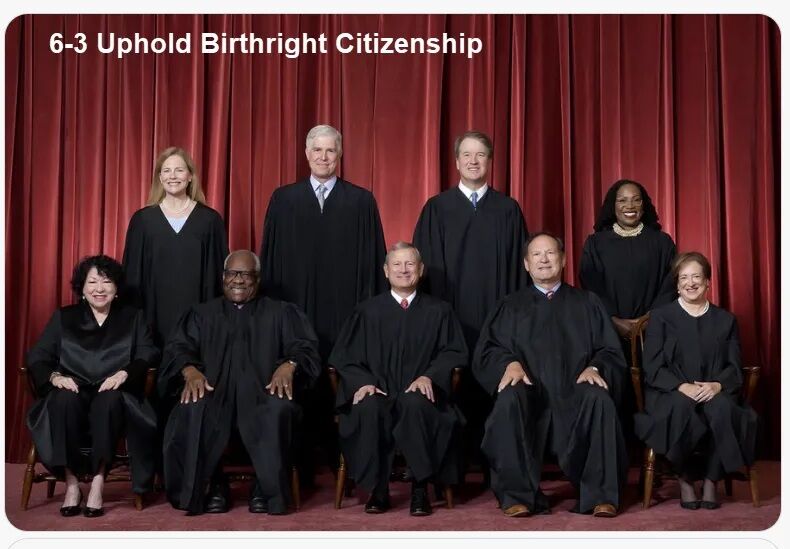
6-3 Ruling
ROBERTS, C. J., delivered the opinion of the Court, in which SOTOMAYOR, KAGAN, BARRETT, and JACKSON, JJ., joined. JACKSON, J., filed a concurring opinion, in which SOTOMAYOR, J., joined as to the introduction and Part I. KAVANAUGH, J., filed an opinion concurring in the judgment and dissenting in part. THOMAS, J., filed a dissenting opinion, in which GORSUCH, J., joined. ALITO, J., and GORSUCH, J., filed dissenting opinions.
Kavanaugh
Justice Kavanaugh agreed with the ruling but wanted to give Congress the opportunity to make modifications.
JUSTICE KAVANAUGH, concurring in the judgment and dissenting in part. Executive Order No. 14160 establishes new exceptions to birthright citizenship for children born to foreign citizens unlawfully or temporarily in the country. 90 Fed. Reg. 8449 (2025). The Court today holds that the Order violates the Fourteenth Amendment to the Constitution. I respectfully disagree with the Court’s constitutional holding. In my view, the Executive Order does not violate the Fourteenth Amendment. But the Order does contravene a federal statute, 8 U. S. C. §1401(a). Congress could—consistent with the Fourteenth Amendment—amend §1401(a) or otherwise enact new legislation establishing exceptions to birthright citizenship for children born to foreign citizens unlawfully or temporarily in the country. But Congress has not yet done so.
Executive Order No. 14160 sought to add two new exceptions to birthright citizenship for children born to foreign citizens who are either illegally or temporarily in the United States. In doing so, the Executive Order goes beyond what §1401(a) authorizes. For the Executive Order to be lawful, therefore, Congress would need to amend §1401(a) or otherwise enact new legislation to encompass those two new exceptions. As of now, Congress has not done so. Over the last 30 years, Congress has considered numerous proposed bills to alter birthright citizenship, but Congress has never actually passed such legislation.
Synopsis
- Birthright Citizenship holds with no restrictions and no outs.
- The final ruling is as predicted in this corner.
- However, I got Gorsuch wrong.
Justice Roberts “The Court exhaustively canvassed the text and history of the Citizenship Clause and at no point identified any evidence that the ratifiers thought themselves to be imposing a domicile limitation.”
I showed the history of the debate and I concur “and at no point identified any evidence that the ratifiers thought themselves to be imposing a domicile limitation.“
We Have Finality, As Predicted Here
Kavanaugh tried to give Congress an out. All that would have done is lead to more endless and useless debate.
It takes 60 votes, and there are never going to be 60 votes to overturn this. The ruling ends the debate.
It will take a Constitutional amendment to change this track.
I told you so, with one missed Justice. Oral arguments led me to believe Gorsuch would go against Trump.
I expected Alito and Thomas to dissent despite the history of the debate in 1866 being completely clear.
Fearless Predictions
Please recall Fearless Predictions, Ten Key Events to Expect in 2026
#1: Trump will Lose His Supreme Court Battle on Reciprocal Tariffs
Expect a 6-3 margin against Trump, possibly 7-2. I rate this a 75 percent chance.
#2: Trump will Lose His Supreme Court Battle on Birthright Citizenship
Expect a 7-2 vote against Trump. 9-0 would not be a surprise. I rate this a 90 percent chance.
#3: Trump will lose his Supreme Court battle over the right to fire Fed governor Lisa Cook.
Expect a 6-3 vote against Trump. I rate this a 80 percent chance.
Synopsis
- I got every justice correct on Reciprocal Tariffs.
- On Birthright Citizenship, I got Gorsuch wrong. But I got the finality correct. This is not a narrow ruling.
- On Lisa Cook, I did not do justice-by-justice but got someone wrong. Cook was 5-4.
Anyone Else Do Better?
Oh, there’s just one more thing. Thank you, President Trump for sealing the fate of this monumental and correct decision.
You are free to dissent, of course. But this case is not about decisions we might make today. It’s about interpreting the law as it exists, not how we want.
The Supreme Court does not rule on the wisdom of the laws or the wisdom of the Constitution. It rules on the law, and it interprets the Constitution.
In that regard, this decision was correct, no matter what you think constitutional framers would do today.
Addendum
DeSantis understands the impact of a broad ruling.
DeSantis: “Well, the decision prevents Congress from doing just that. So, no, he couldn’t have successfully asked Congress. The Court is saying that citizenship is mandated by the Constitution for the children of foreign birth tourists and illegal aliens.“
The Idiot Parade
Weird Gorsuch Dissent
Gorsuch
Finally, just because the executive order has some lawful applications and can survive a facial challenge does not mean it is lawful across the board and immune from narrower legal challenges. Besides addressing temporary visitors, the order also denies the benefits of citizenship to children born in this country to parents who make their permanent home here, but do so in defiance of federal immigration laws. The government insists that aspect of the order can survive any possible legal challenge, too, because individuals can secure domicile in this country only if they do so in compliance with federal law. See ante, at 57–58, n. 10 (THOMAS, J., dissenting). About that, however, I harbor doubts.
Perhaps Wong Kim Ark does not squarely foreclose the government’s position. After all, that case addressed a child born to parents who lawfully resided in this country. Still, I wonder: Is a child born here to parents who have long chosen to make this Nation their permanent home not a citizen under the Fourteenth Amendment solely because his parents’ presence violates statutory law?
If those parents are not domiciled here, then where are they domiciled? And if the answer is nowhere, how can we reconcile that conclusion with this Court’s longstanding recognition that every person is domiciled somewhere? See Desmare v. United States, 93 U. S. 605, 610 (1877).
Because the executive order is not facially invalid, these questions may not be properly before us. But their answers are undeniably important to a Nation committed to a view of citizenship open to all children born here to parents who can call this country their home.
Somehow, Gorsuch tries to justify the Executive Order while poking a big hole in his own dissent.
That makes little sense. I did not do as bad on Gorsuch as it seems at first glance.
Article posted with permission from Mish Shedlock