

Editor’s note: The piece below is excellent at presenting what is being perpetrated by the Trump administration. However, the answer is not more voting or even voting “libertarian”. The answer is for people to govern themselves instead of trusting that another man will do it for you. It’s called repentance towards God.
Trump is 0-18 in the courts. That should tell you something.
Executive Order Background
Trump’s Executive order “mandates that federal agencies create their own voter eligibility lists and imposes those lists on the States through threats of prosecuting States and their elections officials.”
- Buy All-American!
- Bring health and vitality back to your body with these non-transdermal patches
- Get your Vitamin B17 & Get 10% Off With Promo Code TIM
- How To Protect Yourself From 5G, EMF & RF Radiation - Use promo code TIM to save $$$
- The Very Best All-American Made Supplements On The Market
- Grab This Bucket Of Heirloom Seeds & Save with Promo Code TIM
- Here’s A Way You Can Stockpile Food For The Future
- Stockpile Your Ammo & Save $15 On Your First Order
- Preparing Also Means Detoxifying – Here’s One Simple Way To Detoxify
- The Very Best Chlorine Dioxide
- All-American, US Prime, High Choice Grass-Fed Beef with NO mRNA, hormones or antibiotics... ever!
The order stems from Trump’s failure to enact changes to election administration through Congress” with the SAVE America Act.
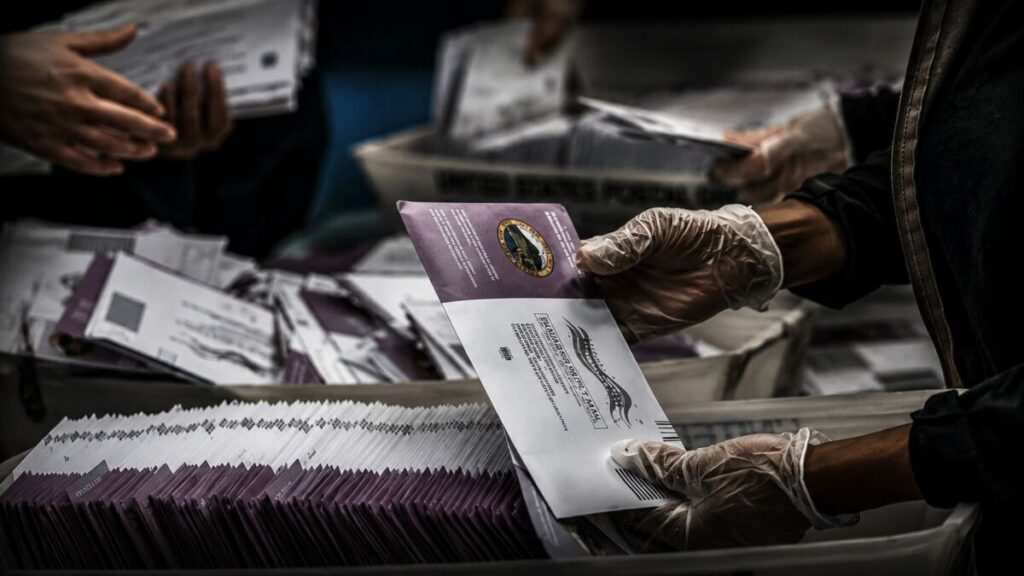
State attorney generals from 22 states and the District of Columbia, along with Pennsylvania Gov. Josh Shapiro, filed a lawsuit in federal court challenging President Donald Trump’s executive order attacking access to mail-in voting.
The lawsuit asserts that the order violates constitutional principles of the separation of powers and state sovereignty over elections. The state officials ask the court to block the order.
United States Court of Appeals For the First Circuit
Please consider United States Court of Appeals for the First Circuit Case 26-1774, 26-1779.
Order of the Court
Under the Constitution, state and local officials are responsible for administering federal elections. In the spring of 2026, President Trump issued an executive order with nationwide effects on how state and local officials can administer federal elections, including the upcoming primary and general elections in September and November. In particular, the executive order directed substantial involvement by the United States Postal Service in deciding which ballots sent to and from voters would be delivered. The plaintiffs in this case — 23 states and the District of Columbia (the “Plaintiff States”) — filed this lawsuit against the President, federal agencies, and agency heads, challenging the executive order as ultra vires and unconstitutional. The district court entered final judgment in favor of the Plaintiff States as to some of their claims and enjoined most of the defendants (but not the President) from implementing certain provisions of the executive order, but only as to federal elections on or before November 3, 2026, and only in the Plaintiff States. The federal defendants and 12 states that intervened in the case in support of the executive order have now filed separate motions seeking a stay of the district court’s injunction pending appeal, arguing only that the Plaintiff States lack standing to bring their claims and that those claims are not ripe. We deny their motions.
Discussion
Although the district court held that the EO is unconstitutional, that question is not presently before us because the Government does not defend the legality of the EO in requesting a stay. Instead, it argues only that the Plaintiff States do not have standing to challenge the EO because their claims are premature.
The Government also does not contest the district court’s assessment of the summary judgment record that informed its final ruling. Before the district court, the Government did not dispute the declarations and other factual submissions by the Plaintiff States.
Finally, the Government has conceded several points in the district court and in its motion to our court. For example, it concedes that the federal defendants have been moving ahead to implement the directives in the EO, including by “[e]stablishing infrastructure to” “compile, maintain, and transmit [the DHS] Citizenship Lists” and “taking steps to create a [USPS] portal” for collecting information about individuals who are eligible to vote by mail.
And the Government has indicated that it may use the DHS Citizenship Lists to conduct investigations and potential criminal prosecutions of state and local officials. As we will explain, these concessions undermine its arguments that the Plaintiff States lack standing to challenge the EO because their claims are premature.
Likelihood of Success on the Merits
The parties’ dispute centers on whether the Plaintiff States have suffered an injury in fact to establish their standing to sue and, relatedly, whether the Plaintiff States’ claims are ripe for review. We conclude that the Government has not made a “strong showing” that it is likely to prevail on its standing and ripeness arguments on appeal.
Article III Injury
The Government focuses on the injury-in-fact requirement and contends that the Plaintiff States’ alleged injuries are merely speculative. According to the Government, the Plaintiff States have not suffered any current or impending injuries from the EO itself and are basing their claims on “potential future actions agencies may take to implement it.” In particular, the Government emphasizes that Section 2(a) imposes no obligations on the Plaintiff States and USPS has not finalized the details of its new rule.
The district court concluded that the Plaintiff States had suffered three current or certainly impending injuries that were sufficient to satisfy the requirements of Article III. In opposing the Government’s stay motion, the Plaintiff States also point to a fourth injury: the EO’s intrusion into their sovereign interests in administering state elections consistent with the Constitution and state statutes. To secure a stay, the Government would need to make a strong showing that it is likely to succeed on appeal in demonstrating that none of these injuries are sufficient to confer Article III standing. We conclude that it has not done so with the arguments presented in the stay motions.
First, the district court concluded that the EO imposed a present injury because it required Plaintiff States to begin planning now on how to comply with its directives, given that the September and November elections were just months away. As the Plaintiff States put it, the EO “require[s] [them] to expend time and resources now to prevent . . . chaos, confusion, and disenfranchisement.”
Second, the district court concluded that the Plaintiff States faced certainly impending pocketbook injuries from the EO’s direction that USPS control the design of envelopes in all federal voting-by-mail processes. In doing so, it relied on the summary judgment record, which indicated that several states had already ordered mail-ballot envelopes for the 2026 federal election cycle around the time they filed their complaint.
Third, the district court concluded that the EO threatens the Plaintiff States and their officials with criminal penalties if they do not comply with its directives and that the “threat is sufficiently imminent for Article III injury.”
The Government’s stay arguments on this issue are further undermined by its representations before the district court. In fact, the Government repeatedly indicated below that the DHS Citizenship Lists could be used to “facilitate . . . post-election law-enforcement activity,” including prosecuting violations of laws that “explicitly prohibit non-citizens from registering to vote.” (Quoting 91 Fed. Reg. at 17125.) And when the district court asked whether the Government would have probable cause to prosecute a state official merely for sending a ballot to someone not on the DHS Citizenship Lists, the Government’s counsel equivocated, stating: “I don’t know the answer to that question, Your Honor.” State and local officials are no exception to the commonsense rule that “[p]eople do not lightly disregard public officers’ thinly veiled threats to institute criminal proceedings against them if they do not come around.”
The EO directs unprecedented levels of involvement by federal officials in how states administer elections. In doing so, the EO plainly affects the Plaintiff States’ “sovereign power . . . to create and enforce a legal code” for elections.
IV. CONCLUSION
For all these reasons, we deny the motions to stay.
Unconstitutional Order
Trump, Homeland Security and 8 defendant states do not challenge the fact that the order is unconstitutional.
They preceded anyway attempting to force states to comply with illegal orders.
That is all you need to know.
Trump does not care, nor does Homeland Security, nor does the Attorney General, nor does the head of Social Security, nor does the Postmaster General, whether or not an executive order is illegal.
More accurately, they know full well Trump’s order is illegal.
Trump is 0-18 in the Courts
Please note DOJ losing streak continues as Trump-appointed judge tosses Kentucky voter roll lawsuit
The Department of Justice’s (DOJ) record in voter roll cases fell to 0-17 Thursday, when yet another federal judge appointed by President Donald Trump dismissed the administration’s lawsuit against Kentucky.
Since Trump returned to office, the DOJ has sought unredacted voter registration records from virtually every state. After 30 states and Washington, D.C. refused, the DOJ sued them under the 1960 Civil Rights Act (CRA) and the National Voter Registration Act (NVRA).
But the agency has lost every single case so far, with Republican-appointed judges ruling against the DOJ in 11 of the cases.
In Kentucky, U.S. District Court Judge Claria Horn Boom became the eighth Trump appointee to dismiss the DOJ’s demand for unfettered access to registration data, holding that federal law didn’t grant the federal government that power.
With the Appeals Court ruling the DOJ is 0-18.
Willing to Enforce Unconstitutional Orders
- Donald Trump, President
- Todd Blanche, Acting United States Attorney General
- Markwayne Mullin, Secretary of the United Stated Department of Homeland Security
- Frank Bisigano, Commissioner of the United States Social Security Administration
- David Steiner, Postmaster General and Chief Executive Officer of the Postal Service
- Doug Tulino, Deputy Postmaster General, Chief Operating Officer, and Chief Human Resources Officer of the Postal Service and Member of the Postal Service Board of Governors
All of the above should be impeached and removed from office for attempting to willingly enforce actions known to be unconstitutional.
Trump’s Effort to Steal the Election
This is a clear effort by Trump and his sycophants to steal the election.
That what unconstitutional orders and going 0-18 means given Republican-appointed judges ruling against the DOJ in 11 of the cases.
Tucker on Republican Priorities
100 Days to the Midterm Election
Taylor Swift
I am no fan of Taylor Swift. However, I endorse the message on her shirt.
Stop the Steal
Trump and his warmongering, racist cult are genuine threats to the United States of America.
Republicans, did you vote for another war, higher inflation, illegal orders, higher deficits?
Don’t tell me your rep is different when he/she votes for all of the above with a couple of exceptions. Few have the courage of Thomas Massie.
There is only one way to stop the steal, stop illegal orders, stop the war, stop Trump’s graft, and find out what is really in the Epstein files.
It pains me to say this, but that way is to vote Republicans out of office regardless of other consequences.
If you can’t stand voting for the lesser of two evils, then do what I do, and that’s vote Libertarian.
When Trump loses the House (and he will), impeachments begin. That is precisely what his all-out efforts to steal the election are about.
Article posted with permission from Mish Shedlock