


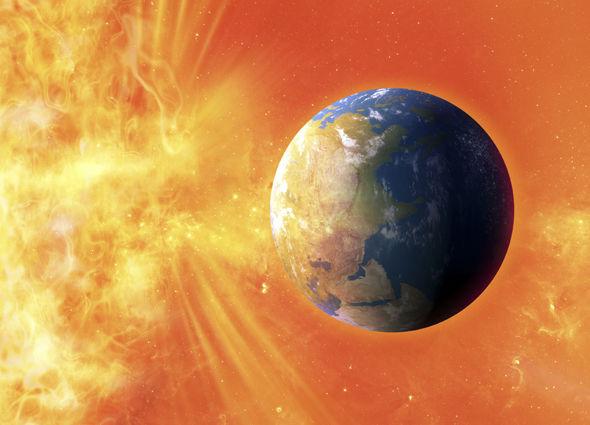
According to the U.S. Agency NOAA (National Oceanic and Atmospheric Administration), a gigantic solar storm is heading towards Earth that could disrupt mobile phones
A solar storm is essentially radiation being deflected towards Earth from the Sun. Something called a coronal hole opens on the Sun, which causes a stream of solar particles to burst towards Earth casting radiation levels high enough to drastically affect technology.
- Buy All-American!
- Bring health and vitality back to your body with these non-transdermal patches
- Get your Vitamin B17 & Get 10% Off With Promo Code TIM
- How To Protect Yourself From 5G, EMF & RF Radiation - Use promo code TIM to save $$$
- The Very Best All-American Made Supplements On The Market
- Grab This Bucket Of Heirloom Seeds & Save with Promo Code TIM
- Here’s A Way You Can Stockpile Food For The Future
- Stockpile Your Ammo & Save $15 On Your First Order
- Preparing Also Means Detoxifying – Here’s One Simple Way To Detoxify
- The Very Best Chlorine Dioxide
- All-American, US Prime, High Choice Grass-Fed Beef with NO mRNA, hormones or antibiotics... ever!
According to SpaceWeatherLive:
“The magnetic field of a coronal hole is different than the rest of the Sun. Instead of returning to the surface, these magnetic field lines stay open and stretch out into space.”
Every day, the atmosphere protects people from the Sun’s radiation. But, depending on how the Sun’s rays heat the outer atmosphere, the heat can affect satellites in orbit, which in turn affects any technology dependent on satellite function– like mobile phones, GPS, or military weapons operations.
If higher currents in the magnetosphere – the Earth’s magnetic field – reach critical levels, the heat and radiation could create a surge of electricity in power lines. In turn, electrical transformers and power stations could temporary lose electricity in an entire region.
In the next few days, a swarm of particles could hit Earth, causing those living in the Northern Hemisphere to be able to see the Northern Lights– for roughly a month’s time, or more than the full rotation of the Sun, which is 28 days.
Article reposted with permission from Constitution.com. Article by Bethany Blankley.