


POWER AND THE CONSTITUTION: June 2026
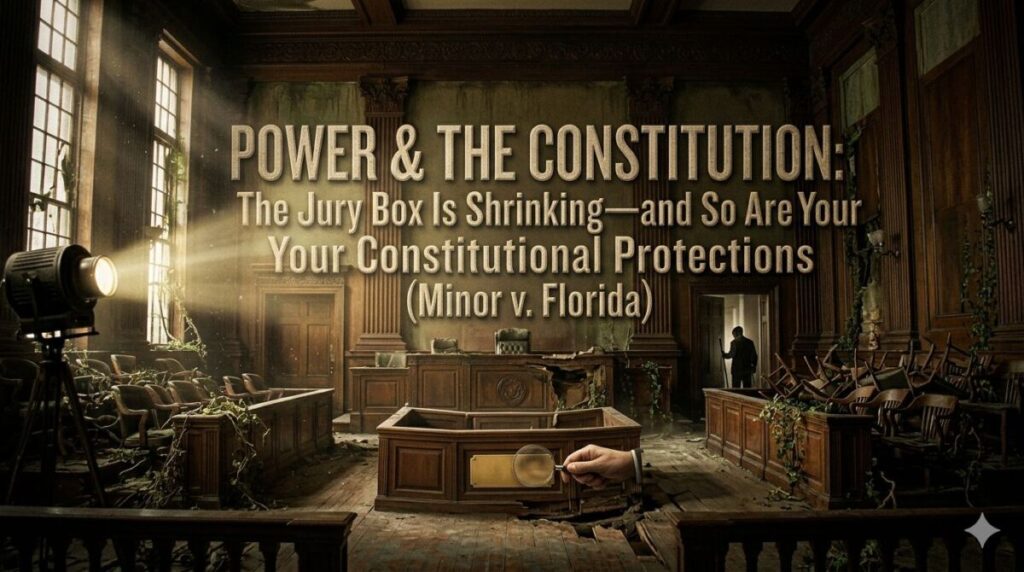
The Jury Box Is Shrinking—and So Are Your Constitutional Protections: Minor v. Florida
Most Americans assume that if they are ever charged with a serious crime, they will be judged by a jury of twelve fellow citizens. That is how the right to trial by jury has been understood for most of American history.
- Buy All-American!
- Bring health and vitality back to your body with these non-transdermal patches
- Get your Vitamin B17 & Get 10% Off With Promo Code TIM
- How To Protect Yourself From 5G, EMF & RF Radiation - Use promo code TIM to save $$$
- The Very Best All-American Made Supplements On The Market
- Grab This Bucket Of Heirloom Seeds & Save with Promo Code TIM
- Here’s A Way You Can Stockpile Food For The Future
- Stockpile Your Ammo & Save $15 On Your First Order
- Preparing Also Means Detoxifying – Here’s One Simple Way To Detoxify
- The Very Best Chlorine Dioxide
- All-American, US Prime, High Choice Grass-Fed Beef with NO mRNA, hormones or antibiotics... ever!
But that protection has been shrinking, like so many of the rights enshrined in the Constitution.
The U.S. Supreme Court’s refusal to hear Minor v. Florida—a case challenging Florida’s practice of allowing criminal defendants to be tried by juries of only six people instead of twelve—may sound like a technical detail. It is not.
The jury system was designed to stand between the individual and the immense power of the government. More jurors mean broader community representation, longer deliberations, greater scrutiny of the evidence, and stronger protection against wrongful convictions.
Smaller juries do the opposite.
At a time when Americans are facing expanding surveillance powers, militarized policing, politicized prosecutions, and growing government authority at every level, constitutional safeguards should be strengthened—not weakened.
The Sixth Amendment exists because the Founders understood a dangerous truth: governments are not always trustworthy when power goes unchecked.
The jury box was meant to be one of the last lines of defense.
The Case: Six Jurors Instead of Twelve
In Minor v. Florida, the Supreme Court declined to hear an appeal challenging Florida’s use of six-person juries in serious criminal cases. As a result, the Court left intact a state system in which defendants facing criminal charges can be tried by juries of only six people instead of the traditional twelve-member jury long understood to be required by the Sixth Amendment.
The Rutherford Institute and the ACLU urged the Supreme Court to hear the case, arguing in an amicus brief that the Founders understood the word “jury” to mean twelve members when the Constitution and Bill of Rights were ratified—and that allowing states to reduce that number undermines both the integrity of the justice system and the constitutional rights of the accused.
“At a time when prosecutors already hold enormous power over the lives and liberties of ordinary Americans, shrinking juries means fewer voices, less deliberation, and fewer safeguards against malicious prosecutions and government abuse,” said constitutional attorney John W. Whitehead, president of The Rutherford Institute and author of Battlefield America: The War on the American People. “The Constitution was designed to restrain the government—not make wrongful convictions easier.”
Florida is one of the few states that still allows smaller criminal juries. As Justice Neil Gorsuch has observed, “only 6 states…tolerate smaller panels [than twelve jurors]—and it is difficult to reconcile their outlying practices with the Constitution.”
What the Sixth Amendment Was Meant to Protect
The Sixth Amendment guarantees that “[i]n all criminal prosecutions,” the accused shall enjoy the right to trial by jury.
The question in Minor was whether that constitutional guarantee can be satisfied by six jurors—or whether the word “jury,” as understood at the Founding, meant what it had long meant under English and American common law: twelve members.
The historical record, as set out in the amicus brief, is clear.
“The Sixth Amendment to the Constitution guarantees the right to trial by jury,” the brief explains. “That guarantee carries with it the Founding-era understanding that the jury—‘the great bulwark of [our] civil and political liberties’—must have twelve members to convict the criminally accused.”
Under English common law, a jury was a body of twelve. A group smaller or larger than twelve could not deliver a valid verdict. That same understanding carried over into American law when the Constitution and Bill of Rights were ratified. As the brief notes, early American courts and legal authorities repeatedly understood the constitutional term “jury” to carry its common-law meaning: twelve members.
This was not a minor procedural preference. It was part of the constitutional architecture of liberty.
As the brief points out, the Supreme Court itself has repeatedly recognized this historical understanding. In Ramos v. Louisiana, the Court reaffirmed that a defendant has a constitutional right to demand that his liberty not be taken except by the “unanimous verdict of a jury of twelve persons.” More recently, in Erlinger v. United States, the Court again recognized that a criminal defendant must be convicted by the “unanimous suffrage of twelve of his equals and neighbours.”
Yet for decades, defendants in a small minority of states have been denied that full protection when their liberty is at stake. The Rutherford Institute and the ACLU warned that this practice “never would have passed muster at our nation’s Founding.”
Why Twelve Jurors Matter
The number matters because juries are not merely bodies that deliver verdicts. They are constitutional checks on government power.
A twelve-member jury is more likely to represent the community, include diverse viewpoints, resist groupthink, and force the government to meet its burden before taking away a person’s liberty.
A smaller jury narrows that protection.
As Justice Gorsuch has warned in a prior dissent addressing this same issue, “a mountain of evidence suggests that, both at the time of the Amendment’s adoption and for most of our Nation’s history, the right to a trial by jury for serious criminal offenses meant a trial before 12 members of the community—nothing less.”
The concern is not merely historical.
Empirical research cited in the case indicates that smaller juries are less likely to reflect diverse viewpoints, more likely to overlook dissenting opinions, and more likely to favor the prosecution. By contrast, twelve-member juries deliberate longer, recall evidence more accurately, and provide stronger safeguards against wrongful convictions and government overreach.
In other words, reducing juries makes it easier for the government to convict.
That should concern every American, especially now.
The Jury as a Barrier Against Tyranny
At common law and at the Founding, the jury right was understood as a guard against tyranny and a guarantor of liberty. John Adams described representative government and trial by jury as “the heart and lungs” of liberty, and Joseph Story described the jury as a “great bulwark” of civil and political liberties.
More than a century ago, G. K. Chesterton made much the same point in his essay “The Twelve Men,” reflecting on his own experience as a juror. Chesterton understood the jury not as an inconvenience to professional justice but as one of its safeguards. Questions of guilt and innocence, he argued, are too important to be left solely to trained experts; they require the judgment of ordinary people who bring conscience, common sense, and human sympathy into the courtroom.
That is the point too often lost in modern criminal justice debates.
The jury exists because the government cannot be trusted to police itself. It exists because prosecutors, judges, police, and politicians should not have unchecked power over the life and liberty of the individual. It exists because, before the state can imprison a person, it must answer not merely to officials in power but to the people themselves.
A jury of twelve does more than weigh evidence. It forces the government to persuade a cross-section of the community. It gives dissenting voices more room to be heard. It creates a stronger barrier against corruption, bias, political pressure, wrongful prosecution, and abuse.
As the amicus brief explains, “the greater number provides greater opportunities for dissenters to put the government to its proof.”
That is not a technicality.
That is the constitutional design.
Constitutional Rights Are Rarely Lost All at Once
The danger in cases like Minor is that they can be made to sound small: Six jurors instead of twelve. A procedural adjustment. A matter of efficiency. A question for the states.
But constitutional rights are rarely destroyed overnight. More often, they are chipped away piece by piece, exception by exception, shortcut by shortcut, until the protection that once existed becomes little more than a formality.
Today it may be smaller juries.
Tomorrow it could be weaker due process protections, broader surveillance powers, expanded police authority, more aggressive prosecutions, or fewer barriers standing between ordinary citizens and the machinery of the state.
That same concern runs through other cases in which courts remove key questions from the people and place them in the hands of judges.
In Green v. Tanner—another case the Supreme Court refused to hear—the issue was not the size of the jury but whether a jury should decide the reasonableness of a police officer’s conduct in mistakenly shooting an innocent person, rather than having a judge decide the issue as a matter of law and dismiss the lawsuit against the officer without a trial.
The constitutional concern is similar: when juries are sidelined, the public loses one of its most important means of holding government officials accountable.
That is why the Supreme Court’s refusal to hear Minor v. Florida matters.
It leaves unresolved a serious constitutional question about whether states may continue to dilute one of the oldest and most important protections in the Bill of Rights. It also allows the government to keep benefiting from a criminal justice system that already gives prosecutors enormous leverage over the accused.
At a time when public distrust in the fairness of the criminal justice system is growing, weakening the jury system only deepens the danger.
The Last Line of Defense
The Founders did not give us the jury trial as a symbolic ritual. They gave it to us as a safeguard against tyranny. They understood that liberty depends on barriers—barriers between the individual and the state, between accusation and punishment, between government power and personal freedom.
The jury box was meant to be one of those barriers.
When that barrier shrinks, government power grows.
This case was never just about the number six versus twelve. It was about whether constitutional safeguards meant to restrain government power will continue to be treated as essential protections—or inconvenient obstacles.
The Rutherford Institute joined with the ACLU in urging the Supreme Court to hear Minor v. Florida because the erosion of constitutional rights cannot be ignored simply because it happens gradually.
From warrantless surveillance and militarized policing to free speech crackdowns and the erosion of due process, The Rutherford Institute continues fighting to preserve the constitutional barriers standing between the individual and the state.
Because once those barriers fall, all that remains is government power—and whatever rights the government decides to leave intact.
The Jury Box Is Shrinking—and So Are Your Constitutional Protections (Minor v. Florida)
Article posted with permission from John Whitehead