



Here at defenseofournation.com, I have been quite critical of the Supreme Court’s reluctance to grant certiorari to any of the assault weapon ban cases plaguing the nation. On Tuesday, June 30th, they finally agreed to hear two of these cases. Viramontes v. Cook County, out of Illinois, and Grant v. Higgins, out of Connecticut. Like usual, I have questions. Two years ago, the court denied cert to Barnett v. Raoul, which was a challenge to the statewide ban in Illinois. The Seventh Circuit initially upheld the ban while arguing the Second Amendment was not implicated in the case. The state of Illinois argued that the constitution does not protect military-style firearms, and AR-15-style rifles constitute dangerous and unusual weapons that are not in common use for self-defense. The court denied cert because it has not reached its final judgment phase and is still in appellate review. Grant v. Higgins challenges Connecticut’s ban at the state level, again addressing the right to own semi-automatic rifles that are in common use for self-defense and hunting. Perhaps a victory there will eliminate the need to hear Barnett v. Raoul altogether. The court will essentially be addressing the question of whether semi-automatic rifles are protected under the Constitution or if they fall under the dangerous and unusual category.
It almost seems like a no-brainer. The court ruled in 2022 that modern firearm laws must be in line with the nation’s historical tradition of firearm ownership and the plain text meaning of the Second Amendment. Can they really uphold that? Are they upholding that? At the time of the founding, was there a National Firearms Act, background checks, or licensing to carry? Did you have to prove your innocence to the government before purchasing a firearm? Isn’t that what a background check is? Were the founders sitting around waiting for the courts to define their rights? The Bruen decision also eliminated the so-called “interest balancing” tests commonly employed by lower courts to uphold gun control laws. Did the Supreme Court really eliminate that? Let’s be honest for a moment. If the court meant what they said in Bruen, then we would be bringing back the citizen militia and arming them with fully automatic weapons. Isn’t that the real historical context of the Second Amendment? The muzzle loaders of the time were modern military technology, and there were no restrictions on who could own them. Let’s take this one step further. The nation itself exists because citizens took up military arms in response to British attempts at confiscation. Is the court going to acknowledge that? Probably not; however, that is the real history and tradition of guns in America.
Many commentators argue that the Bruen ruling drives a nail in gun control because of the text, history, and tradition standard. The truth, however, is that Bruen is very narrow in scope, primarily dealing with licensing requirements. They essentially ruled against New York, saying that licensing regimes that require unnecessary burdens or justifications are unconstitutional. The one part of Bruen no one talks about is footnote 9. Here, the court noted that “licensing regimes with clear, objective, and non-discretionary criteria are generally permissible.” How so? How is requiring someone to obtain a license to exercise a constitutionally protected right constitutional? It isn’t. In fact, this ruling completely contradicts Murdock v. Pennsylvania, where the court said that no state shall convert a liberty to a license and charge a fee. While this was a First Amendment case, it highlights an important concept. Requiring a license to exercise a right then converts that right into a privilege. They also argued that because a state grants a citizen a permit without requiring proof of a need, it is not an infringement on their Second Amendment rights. Essentially, the court, in its Bruen decision, ignored one of the fundamental principles it was allegedly enforcing in the text, history, and tradition standard because at the time of the founding, there was no permitting process at all.
- Buy All-American!
- Bring health and vitality back to your body with these non-transdermal patches
- Get your Vitamin B17 & Get 10% Off With Promo Code TIM
- How To Protect Yourself From 5G, EMF & RF Radiation - Use promo code TIM to save $$$
- The Very Best All-American Made Supplements On The Market
- Grab This Bucket Of Heirloom Seeds & Save with Promo Code TIM
- Here’s A Way You Can Stockpile Food For The Future
- Stockpile Your Ammo & Save $15 On Your First Order
- Preparing Also Means Detoxifying – Here’s One Simple Way To Detoxify
- The Very Best Chlorine Dioxide
- All-American, US Prime, High Choice Grass-Fed Beef with NO mRNA, hormones or antibiotics... ever!
This isn’t to say we haven’t had any significant victories the past couple of weeks. For instance, in Wolford v. Lopez, the court ruled that the state cannot institute a blanket law banning the exercise of a protected right on private property. In essence, Hawaii passed a law stating that people with a concealed carry permit must obtain permission from the business owner before carrying a weapon on their property. The general assumption is that private businesses are open to the public, where everyday citizens are conducting daily business; therefore, the right to carry extends to those properties. The court upheld this. In many states, and it probably applies everywhere, a business owner is free to ban weapons on their property with a no-gun sign and charge those who don’t comply with trespassing. In another case called United States v. Hemani, the court ruled that the government cannot willfully place anyone, for any reason—specifically when it comes to drug use—in a dangerousness category without proof. That is a pretty significant ruling that will potentially have major implications for red flag laws.
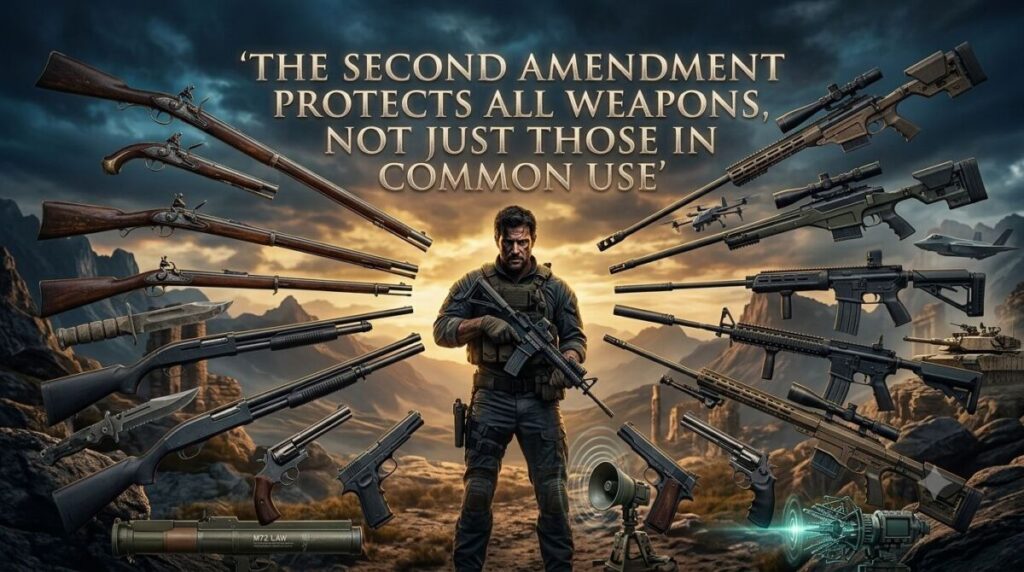
Here is something that no one is talking about. Neither of these cases is really addressing the Second Amendment in its original context. Are they? Most gun rights advocates argue that the Second Amendment is not for hunting or even self-defense. The Second Amendment exists to protect the right to liberty. Are we living in a state of liberty while we are waiting for a court to decide the legality of owning a semi-automatic rifle? No, we are not. The language being discussed here is whether the Second Amendment protects AR-15 rifles as being in common use for self-defense. It wouldn’t matter if they are in common use or not. The Second Amendment says nothing about common use for self-defense. It says the right of the people to keep and bear arms shall not be infringed, period. While the court has ruled that arms in common use for lawful purposes cannot be banned, should any weapon, if strictly adhering to constitutional principles, be banned at all? No. The truth is that there should be no gun bans.
As previously noted, the history of this country is rooted in the idea of the citizen militia. It was reasoned that an armed citizenry, as opposed to a standing military, was the best possible defense the country could have. It was the citizen militia that initially stood against the British in the war for independence. While many people, mostly anti-gun leftists, argue that the citizen militia is now made up of the National Guard, that isn’t necessarily the case. Many state constitutions still protect the right of individuals to be armed in defense of the state, as well as self-defense. In my opinion, they are attempting to change the meaning of the Second Amendment to be strictly about self-defense and not a means of defending liberty from a tyrannical government or in defense of the nation against an invading army. Theoretically speaking, if they are successful in creating that perception, then the types of arms seen as reasonable weapons for self-defense can be regulated. If the court was truly going by its own 2022 ruling, the NFA would be repealed, background checks would be done away with, and licensing regimes like the ones they call “generally permissible” would be a thing of the past. None of those things existed at the time of the founding.
It seems logical to assume the court will rule in gun owners’ favor. They probably will within the narrow confines of the cases being heard. However, it can’t be guaranteed. It is possible they find AR-15s to be dangerous and unusual weapons. They probably won’t, as it would be impossible to suggest they are not in common use. What will a victory in these cases really mean? Is it going to stop the anti-gun left? No. What happened after Bruen? New York and other states doubled down on their gun control efforts, and people were still subject to the same types of laws that Bruen was supposed to undo. What will happen if they ever institute a Chinese-style social credit system and a CBDC? We are already hearing stories of corporations issuing credit cards that limit spending based on carbon emissions. The bigger point that needs to be made, however, is that rights are inherent to our being simply because we exist. The right to self-defense and to live in a state of freedom is a natural right that cannot be taken from us. I guess the real question is, what will people do if the court doesn’t rule in our favor?
If you enjoyed this article, be sure to look out for my latest book, The Psychology of Persuasive Propaganda: The Things You Should Know. In the meantime, you can check out –
Without a Shot Indeed: Inducing Compliance to Tyranny Through Conditioning and Persuasion.

and A Critical Look at CRT in Education, Research and Social Policy

Article posted with permission from David Risselada