
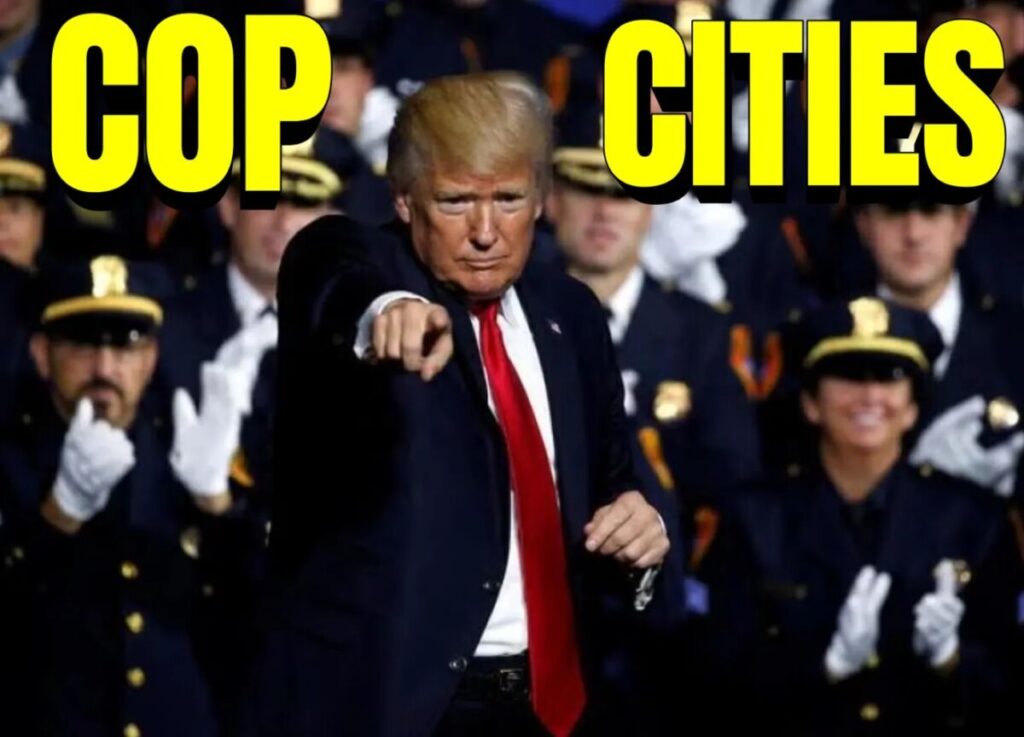
The Justice Department will hand millions to whichever cities prove they can police their people hardest.
This week the Justice Department announced what it calls the Model Cities Initiative, a 300 million dollar pool of grant money that cities will compete for by promising to reduce violent crime and “restore law and order.” Any city or local government representing more than 100,000 people has until September 1 to apply, with the winners chosen late this year.
Acting Attorney General Todd Blanche framed it as a way to supercharge law enforcement partners and help the cities that help the administration make America safe again, which makes it obvious that the money is a reward for political alignment. This will create a contest of brutality, where police departments around the country will compete to show who can be the most repressive.
The name itself makes the whole thing seem like a sick joke, because Model Cities was already a federal program, launched by Lyndon Johnson in 1966. The program sought to alleviate poverty by improving access to housing, health, education, and jobs. That approach is similar in spirit to what Zohran Mamdani is doing in New York City. Sadly, the original Model Cities project never got the funding it deserved and was killed by Nixon less than ten years later. Still, the premise behind the name was correct. Cities are safer when most of the population is not living in desperation. Now, decades later, the government is reviving the name for an effort that is not a war on poverty, but a war on the poor.
- Buy All-American!
- Bring health and vitality back to your body with these non-transdermal patches
- Get your Vitamin B17 & Get 10% Off With Promo Code TIM
- How To Protect Yourself From 5G, EMF & RF Radiation - Use promo code TIM to save $$$
- The Very Best All-American Made Supplements On The Market
- Grab This Bucket Of Heirloom Seeds & Save with Promo Code TIM
- Here’s A Way You Can Stockpile Food For The Future
- Stockpile Your Ammo & Save $15 On Your First Order
- Preparing Also Means Detoxifying – Here’s One Simple Way To Detoxify
- The Very Best Chlorine Dioxide
- All-American, US Prime, High Choice Grass-Fed Beef with NO mRNA, hormones or antibiotics... ever!
The people on the receiving end of all this will be the poorest and most vulnerable in any city, because the program is built to push more police into poor neighborhoods and widen the range of tactics they use there. The clearest target is the homeless, who Trump has spent years casting as the face of crime. His July executive order already redirects federal money toward cities that clear encampments and force people off the street into treatment or confinement, which means Model Cities is just the next installment of a strategy that pays local governments to criminalize poverty.
While poverty has certainly become more visible in cities across the United States, crime is not exploding in the way that the administration insists. In reality, crime has been declining since the early 1990s, not counting a brief spike in 2020. The 2025 drop continued a trend that was already well underway before Trump took office. When Trump declared a crime emergency in DC last August, he federalized the city’s Metropolitan Police Department under the Home Rule Act and put more than 2,000 National Guard troops on the streets, even though the Justice Department’s own data showed crime in the city had hit a 30-year low, a figure the administration found so inconvenient that it disputed its own numbers and asked the DOJ to investigate them. Those troops spent most of their deployment patrolling federal property and picking up trash at parks.
Nobody in government seems willing to push back against Trump’s police state agenda, even in the so-called opposition party. After the troops were deployed in DC, Mayor Muriel Bowser, a Democrat, went along with it, as did Memphis Mayor Paul Young, who also agreed to continue the deployment despite initially claiming that he wasn’t happy about it. At the end of the day, Democrats have the same “law and order” mentality that Republicans do, so this money will draw applications from blue cities as eagerly as red ones.
The Model Cities funding will create permanent infrastructure, and the chances of it being dismantled once it’s in place are very low. We told ourselves after Bush that the next administration would close Guantanamo, end the wars, and roll back the surveillance apparatus, but Guantanamo is still open, the wars have expanded, and the spying has been legalized and normalized over multiple administrations.
A future administration might take down Trump’s tacky ballroom and dismantle the UFC thunderdome he’s building on the White House lawn, because the superficial stuff is easy to undo, but it is unlikely that anyone in Washington is going to dismantle the ICE detention centers or unwind a federal grant pipeline like Model Cities. Each expansion becomes the new baseline that the next expansion builds on, and the emergency powers a president claims in a crisis become the ordinary powers their successors inherit.
Article posted with permission from John Vibes