



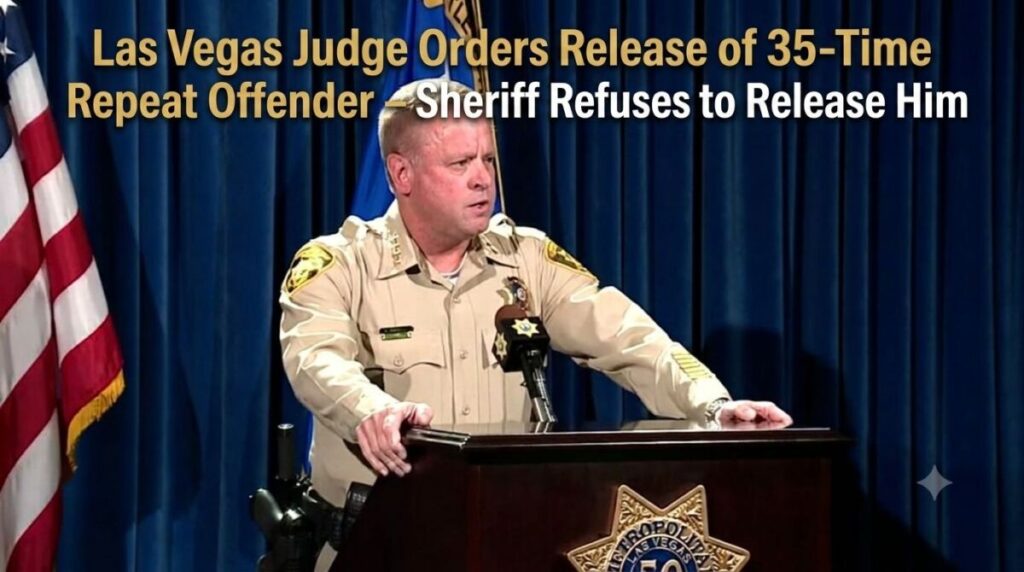
The interposition of a sheriff in Clark County, Nevada – in which Las Vegas is the county seat – has caused a show-down between the judicial and executive branches of government. Sheriff Kevin McMahill has refused a judge’s order to release a repeat offender. Sheriff McMahill cited Nevada Revised Statute 211.250, which states a sheriff can deny certain releases if they create an “unreasonable risk to public safety.”
Judge Eric Goodman has threatened Sheriff McMahill with contempt of court if he does not comply with the court’s ruling.
The repeat offender, Joshua Sanchez-Lopez, has been arrested 35 times, including for “substantial battery.”
- Buy All-American!
- Bring health and vitality back to your body with these non-transdermal patches
- Get your Vitamin B17 & Get 10% Off With Promo Code TIM
- How To Protect Yourself From 5G, EMF & RF Radiation - Use promo code TIM to save $$$
- The Very Best All-American Made Supplements On The Market
- Grab This Bucket Of Heirloom Seeds & Save with Promo Code TIM
- Here’s A Way You Can Stockpile Food For The Future
- Stockpile Your Ammo & Save $15 On Your First Order
- Preparing Also Means Detoxifying – Here’s One Simple Way To Detoxify
- The Very Best Chlorine Dioxide
- All-American, US Prime, High Choice Grass-Fed Beef with NO mRNA, hormones or antibiotics... ever!
Mike Dickerson, assistant general counsel for Sheriff McMahill stated: “The safety of the public is key, and the key here is Sheriff McMahill will not violate the law to appease the Las Vegas Justice Court and let out people who he deems to be dangerous.”
Sanchez-Lopez’s public defender, P. David Westbrook, fired back, stating, “The cops are flat wrong. It is the job of the elected judge to decide whether someone charged with a crime should be released and under what conditions. The idea that a Metro employee can overrule a judge’s release order and keep someone locked up should worry anyone who believes in the Constitution and the rule of law.”
Click here to learn more about this unfolding story.
Click here for more.
Click here for more.
The Lesser Magistrate Doctrine teaches that when the superior or higher ranking civil authority makes unjust/immoral law, policy, or court opinion – the lower or lesser ranking civil authority has both the God-given right and duty to refuse obedience to that superior authority; and if necessary, actively resist the superior authority.
The doctrine was first formalized by Christian men in Magdeburg, Germany in 1550.
The lesser magistrate doctrine is rooted in the historic Christian doctrine of interposition. Interposition is where one steps into the gap – placing themselves in between the oppressor and his intended victim. Interposition can take place verbally or physically.
The law of God is the objective standard to which all men and all governments of men are accountable. If civil authorities make law, policy, or court opinion that is contrary to His law – the lesser magistrates are to interpose and stop the evil.
Get the book – over 150,000 sold!

America’s founders established this nation as a true federalism. In a true federalism there are multiple levels of government and multiple branches on each level. They did this because they held to a Christian view of man – that he is wicked and in need of a Savior.
They did not want power to rest in one man or a small group of men.
The intent, therefore, of federalism is: if any one branch begins to play the tyrant, it is the duty of the other branches to interpose and resist that branch – and stop the evil. The duty of the people is to rally with the interposing magistrates.
All public authorities (magistrates) possess lawful authority. If federal authorities do wrong, it is the duty of state, county, and local authorities to step in and stop the evil. If state authorities do wrong, it is the duty of county and local officials to step in and stop the evil.
State, county, and local magistrates take an oath to uphold both their State Constitution and the U.S. Constitution. They do not take an oath of subservience to the federal government, nor do they take an oath to blindly obey the authority above them.
Rather, they take an oath to uphold the constitutions. If, therefore, another authority makes law, policy, or court opinion repugnant to the state or federal constitutions – they should not obey them.
God has established four realms of government to which He delegates authority. They are: (1) self-government; (2) family government; (3) church government; and (4) civil government. Each has its own role, function, and limits.
The authority an individual possesses in any one of these four realms of government is delegated authority. In other words, they derive their authority from God. Their authority is not autonomous or unconditional. Their authority is God-given, and thus, they have a duty to govern in accordance with His rule.
When someone in authority makes laws or decrees contrary to God’s law, they are in rebellion to God’s rule. Those under their authority are NOT to obey them when they do this. They may even have to actively resist them.
Article posted with permission from Matt Trewhella